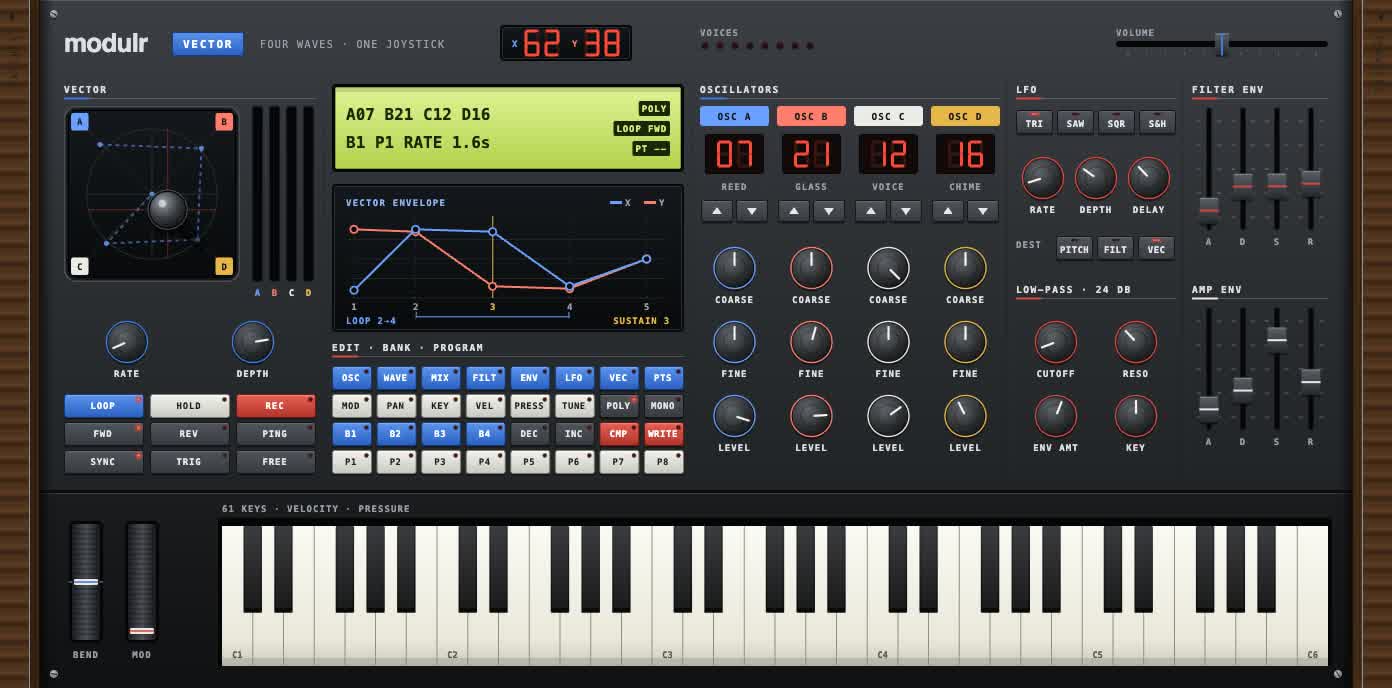
The plug-in itself, playing Glass Drift · the start. No effects added, no mastering.
Legendary · study 21 of 43
Modulr Vector
Four waves mixed around a square by a vector joystick, and a five-point vector envelope that moves the stick by itself, played from your keyboard as a VST3 and Audio Unit.
Modulr Vector is a vector synthesizer after the grammar of the 1986 Prophet VS: four oscillators with one of thirty-two waves each, mixed by a joystick over a square and moved by a five-point vector envelope, then a 24 dB low-pass filter, an LFO and two envelopes, with a chorus, two wheels and a 61-key keybed. It plays eight voices, or one, and it is a VST3 and Audio Unit plug-in.
60 controlsevery one can be automated from your music software
13 patchesthirteen distinct sounds; each one loads every control at once
VST3 · AUApple silicon, macOS 11 or later
Hear it
Thirteen sounds, played as they ship.
Each clip is the plug-in itself: a patch is picked in the drawer and loaded, then a played line sounds on it, the way it is played into the plug-in from a keyboard. The bank holds thirteen patches that make thirteen distinct sounds, these are all of them. No effects added, no mastering.
Glass Drift · the startPad · VectorThe panel’s own starting sound: reed, glass, voice and chime waves mixed by the joystick while the vector envelope drifts the mix. The settings are this product’s reading of the sound, not a factory program of any instrument.Brass StabBrass and Strings · BrassTwo brass waves an octave apart over a saw and a square, with a quick filter snap and a short decay. The settings are this product’s reading of the sound, not a factory program of any instrument.Warm StringsBrass and Strings · StringsTwo string waves and a choir wave, slightly detuned, with a slow attack, a long release and a little vibrato. The settings are this product’s reading of the sound, not a factory program of any instrument.Sub BassBass · SubA square and a sine an octave down with a saw added, the filter closed low: a round low line. The settings are this product’s reading of the sound, not a factory program of any instrument.Bell KeysKeys · BellBell, chime and tine waves with a sine an octave up: a struck note that rings and fades. The settings are this product’s reading of the sound, not a factory program of any instrument.Marimba PluckKeys · MalletMarimba, harp and pluck waves with a short decay and no sustain: a mallet that dies away. The settings are this product’s reading of the sound, not a factory program of any instrument.Choir MorphPad · VocalChoir, voice and formant waves with the vector envelope running wide and slow, so the vowel changes as the note holds. The settings are this product’s reading of the sound, not a factory program of any instrument.Sync LeadLead · MonoTwo sync-lead waves, a saw and a fifth up, played mono with a delayed vibrato. The settings are this product’s reading of the sound, not a factory program of any instrument.Organ DrawbarsKeys · OrganOrgan and square waves stacked at the octaves with the filter open and no movement: a steady organ tone. The settings are this product’s reading of the sound, not a factory program of any instrument.Stairs RunnerSequence · ArpThe stairs and digital waves with the vector envelope running fast and looping, so the mix steps through its corners. The settings are this product’s reading of the sound, not a factory program of any instrument.Metal HitFX · MetalMetal, noise and buzz waves with the filter swept by the LFO and a quick decay: a struck, ringing hit. The settings are this product’s reading of the sound, not a factory program of any instrument.Reed SoloLead · ReedReed, clarinet and oboe waves with a gentle vibrato after a pause: a breathy woodwind line. The settings are this product’s reading of the sound, not a factory program of any instrument.Dark DronePad · DroneA triangle, a square and noise held an octave down under a closed filter the LFO opens and shuts: a slow, dark bed. The settings are this product’s reading of the sound, not a factory program of any instrument.
The study
The editor, and the module it becomes.
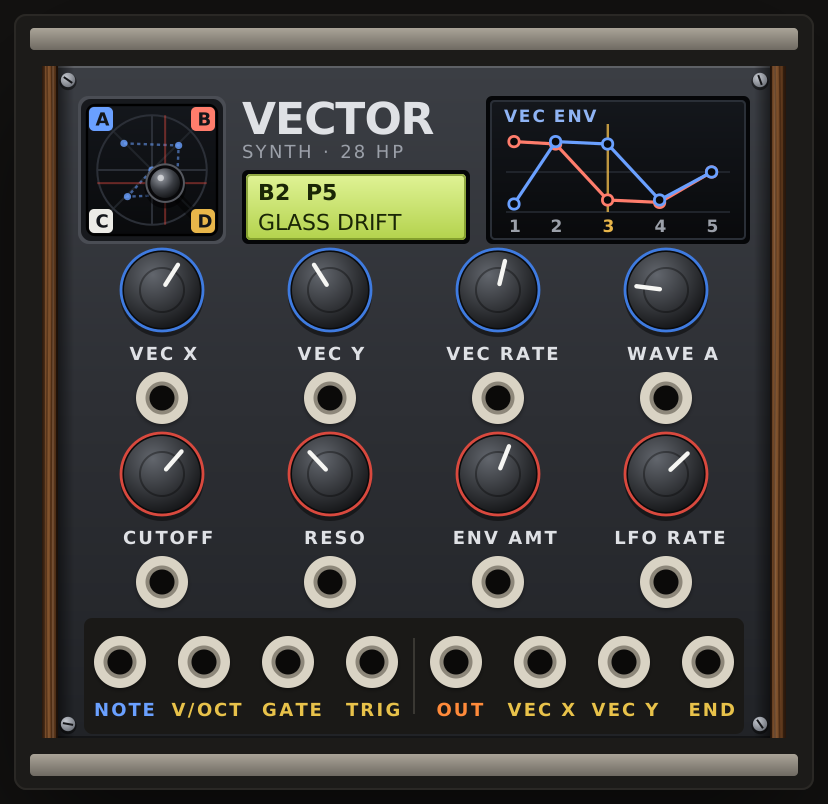
The plug-in is built, and its editor is shown playing a patch. The Eurorack module drawn beside it, with its macro knobs and the control jacks under them, is a design study and is not built.
The Modulr Vector editor, playing a patch: the joystick well, a green LCD, the five-point vector envelope on dark glass, a lit grid of membrane keys, four oscillator strips and a 61-key keyboard.The same study as a 28 HP module: joystick, LCD and vector envelope above eight macro knobs, each with a control jack under it.
The editor is the plug-in’s own, captured as it plays. The module is drawn by the specification’s own kit, and its values are illustrative, not measured. The design is Prophet VS’s grammar, redrawn in Modulr’s own words, and nothing on it is measured against the instrument.
The instrument it studies
Prophet VS, 1986.
The instrument’s own grammar, as the catalogue recalls it: the sections, the controls and the look the study borrows.
The vector-synth grammar: four oscillators with a wave number each, mixed by one joystick over a square and moved by a five-point vector envelope, then a 24 dB low-pass, LFO and envelopes, with a lit membrane matrix for edit, bank and program instead of a knob for every parameter.
A charcoal panel between wide walnut cheeks: a square joystick well with the four oscillator corners A to D, a bright green LCD, a five-point vector envelope on a dark glass, a lit grid of blue, red, white and dark rubber membrane keys and charcoal knobs with coloured skirts.
A vector joystick mixing four waves (A, B, C, D) around a square
Four oscillators, each with a wave select from 32 waves
A 24 dB low-pass filter: cutoff, resonance, envelope amount, keyboard
A vector envelope of five points drawn in a display
An LFO
Envelope generators
A small LCD, with bank and program buttons
A lit key matrix for parameter selection, and 61 keys
The spec sheet
The module, knob by knob.
The module is a design study and is not built. Its macros are the signature controls a player reaches for, not a generic set; each one has a control jack under it.
Macro
Key
Range
Default
Vec X
vec.x
0–100%
50%
Vec Y
vec.y
0–100%
50%
Vec rate
venv.rate
40 ms – 20 s
1.0 s
Wave A
osc.a.wave
01 – 32
01
Cutoff
vcf.cut
20 Hz – 20 kHz
20 kHz
Reso
vcf.res
0–100%
0%
Env amt
vcf.env
0–100%
0%
LFO rate
lfo.rate
0.05 – 50 Hz
5 Hz
Side
Jacks
In
Note (MIDI), V/Oct (CV), Gate (CV), Trig (CV)
Out
Out (Audio), Vec X (CV), Vec Y (CV), End (CV)
The plug-in is built and on sale. The module is not.On saleModulr Vector is a working VST3 and Audio Unit and it is $25. It is not a copy of any instrument: no maker’s name or logo is drawn on a panel, and nothing is measured against the original. It is signed ad hoc, not notarized, so macOS will ask you to allow it. A downloaded copy stays silent until it is licensed, and there is no automatic way yet for a customer to receive a licence file. The edit, bank and program keys on the face are drawn but do not act in the plug-in (the host keeps the presets, and the drawer holds the patches), and there is no sequencer. The sound bank is thirteen patches of thirteen distinct tones; they are the product’s reading of a sound, and none is a factory program of any instrument.
Legendary is the catalogue of the Modulr Synths project: 43 design studies drawn with the specification’s own kit, 33 after the synthesizers of all time and 10 after the drum machines. The makers and years named here are the instrument’s; the names, the layouts and every value are Modulr’s own.