Modulr Cell
One voice: two oscillators, a filter that sweeps from low-pass to notch to high-pass, and two envelopes.
Modulr Cell is a synthesizer voice after the grammar of a 1974 analogue voice module. Two oscillators with sync and a fine tune, a 12 dB state-variable filter whose one mode knob runs low-pass to notch to high-pass, with a band-pass key, an LFO with four shapes, two ADSR envelopes, glide and a drive stage. Fifty patches, each loading the whole sound at once.
Eight patches, played as they ship.
Each clip is the plug-in itself: the patch is picked in the drawer and loaded, a short phrase is played on it, and the cutoff is swept over the take. Each patch is named for a record it is after; its settings are Modulr’s reading of the sound’s role, not the artist’s own. The sound is the instrument’s own output, with no effects and no mastering.
A voice you load, then play.
- Patches that load the whole sound.Pick a patch and every control moves to it at once, and the display names it; the drawer closes and the voice is ready to play.
- Hold to preview.Hold a key to hear a patch’s tone on your own MIDI, then let go and the instrument is exactly as it was.
- Two oscillators.Saw, pulse or triangle on each, a pulse width, a fine tune, a second-oscillator pitch and a hard sync from the first.
- One filter, many voices.A 12 dB state-variable filter from low-pass through notch to high-pass, a band-pass key, an inverted envelope, and the key’s velocity opening the cutoff.
- Services.Choose whether the instrument answers your host’s MIDI and clock, set its output level, and age it: the decay shortens, the tuning drifts flat and the resonance rings less.
What it needs.
| Format | Systems | Licence |
|---|---|---|
| VST3 · Audio Unit | macOS 11 or later, on Apple silicon | A licence is needed to make sound. Without one the editor opens and the output is silent. |
The editor, and the module it becomes.
The plug-in is built. The Eurorack module is drawn, with its macro knobs and the control jacks under them, and is not.
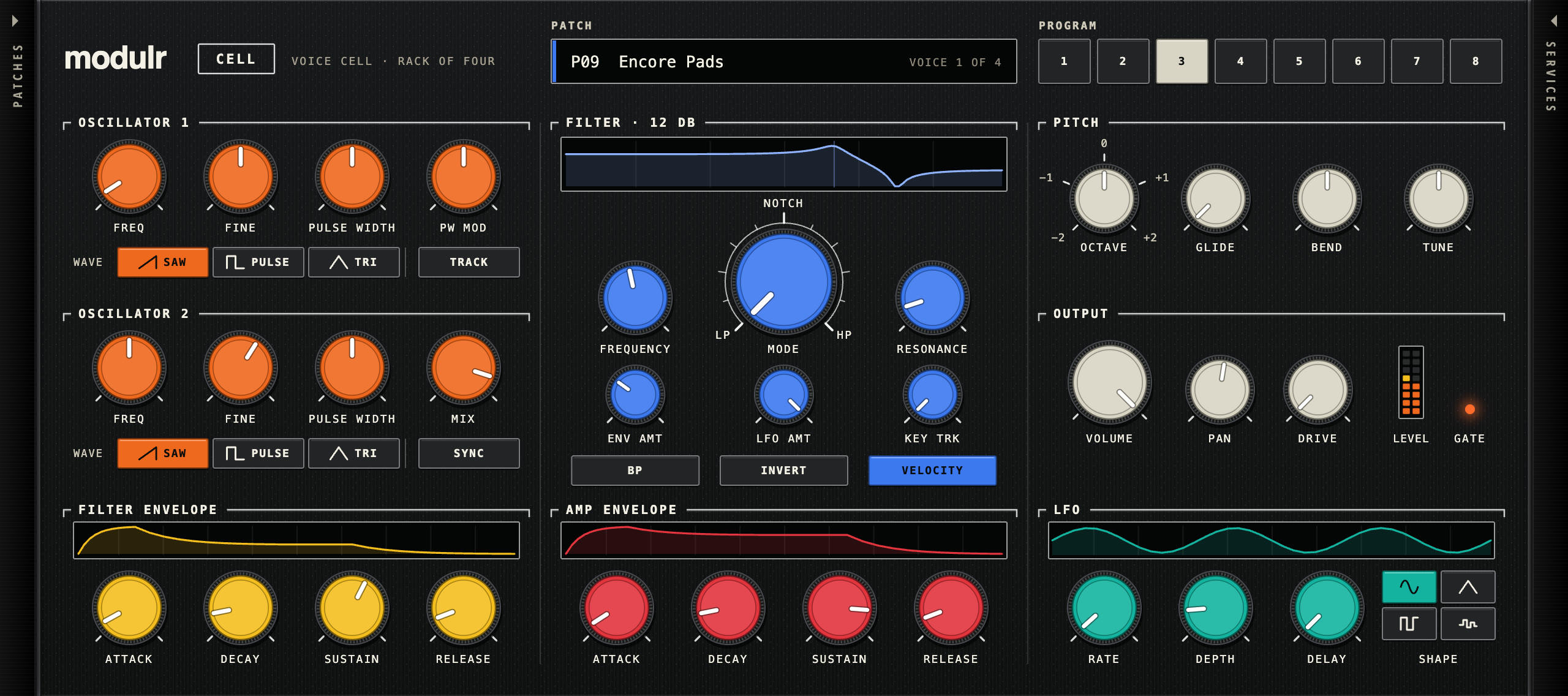
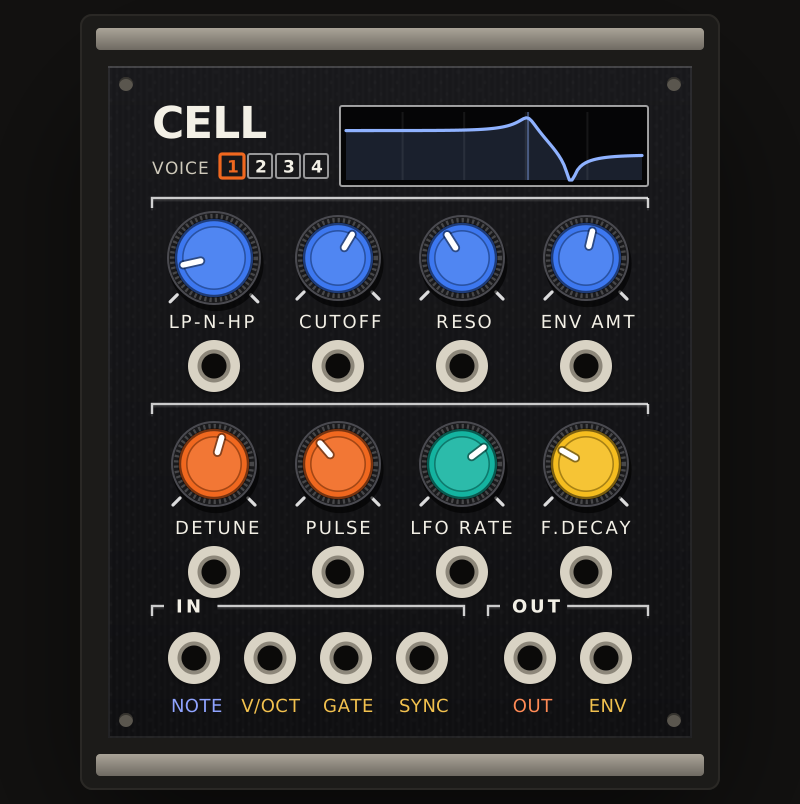
The editor is the plug-in’s own, as it opens. The module is drawn by the specification’s own kit, and its values are illustrative, not measured. The design is SEM’s grammar, redrawn in Modulr’s own words, and nothing on it is measured against the instrument.
SEM, 1974.
The instrument’s own grammar, as the catalogue recalls it: the sections, the controls and the look the study borrows.
The expandable-voice grammar: two oscillators, a 12 dB state-variable filter whose one big mode knob sweeps low-pass through notch to high-pass, an LFO and two ADSR envelopes, one cap per job in ruled colour-coded sections, and a voice that stacks to four in the rack.
A matte black anodised 22 HP panel with white engraved rules and capital lettering, chunky solid colour caps on ribbed black skirts (blue filter, orange oscillators, teal LFO, yellow envelope), the filter response in a ruled window and the jacks under open brackets.
- Two VCOs: frequency, waveform, pulse width, fine tune
- A 12 dB state-variable filter: cutoff, resonance, envelope amount, and a low-pass to notch to high-pass mode knob
- An LFO with rate, depth and waveform
- Two ADSR envelopes: filter and amplifier
- A pitch control with a knob for the octave
- Four-voice expandability: a rack of several voices
The module, knob by knob.
The module is a design study and is not built. Its macros are the signature controls a player reaches for, not a generic set; each one has a control jack under it.
| Macro | Key | Range | Default |
|---|---|---|---|
| LP-N-HP | vcf.mode | LP – notch – HP | LP |
| Cutoff | vcf.cut | 20 Hz – 20 kHz | 20 kHz |
| Reso | vcf.res | 0–100% | 0% |
| Env amt | vcf.env | 0–100% | 0% |
| Detune | vco2.fine | ±50 ct | 0 ct |
| Pulse | vco1.pw | 5–95% | 50% |
| LFO rate | lfo.rate | 0.05 – 40 Hz | 4 Hz |
| F.Decay | fenv.decay | 0 ms – 20 s | 200 ms |
| Side | Jacks |
|---|---|
| In | Note (MIDI), V/Oct (CV), Gate (CV), Sync (CV) |
| Out | Out (Audio), Env (CV) |
Legendary is the catalogue of the Modulr Synths project: 43 design studies drawn with the specification’s own kit, 33 after the synthesizers of all time and 10 after the drum machines. The makers and years named here are the instrument’s; the names, the layouts and every value are Modulr’s own.