Modulr Table
Sixty-four waves on a table, one large knob to sweep them, and a resonant filter with envelopes of its own.
Modulr Table is an eight-voice wavetable synthesizer after the grammar of a 1982 digital-analogue instrument: eight tables of sixty-four waves swept by one large knob and moved by an envelope and an LFO, a sub oscillator and noise, a resonant low-pass with its own envelope, and square keys with LEDs that choose the control a single Value fader sets. It is a VST3 and Audio Unit for Apple silicon.
Three sounds, played as they ship.
Each clip is the plug-in itself: a patch is picked in the drawer and loaded, then a played chord or line sounds on it, the way it is played into the plug-in from a keyboard. The twenty-six patches hold three distinct sounds, one for each clip here. No source documents a setting on the instrument these records were made on, so the artist-named patches are this product’s reading of each sound’s role, not the artist’s own setting.
Sixty-four waves, one knob.
- Eight tables of sixty-four waves.The Wave knob picks one of the sixty-four, a wave envelope moves it over the note, and the wave LFO sweeps it; eight keys choose the table.
- A sub oscillator and noise.Mixed with the table oscillator, with a detune and a tune of their own.
- A low-pass filter.Cutoff, resonance, an envelope amount that can be inverted, key follow and velocity, with a choice of two slopes and a drive.
- Three envelopes and an LFO.A filter, an amplifier and a wave envelope, each with attack, decay, sustain and release, chosen by the envelope’s tabs; an LFO of four shapes with a depth, a rate and a delay.
- The function keys and the Value fader.A key chooses the control the one Value fader edits, and the step keys move it a stop at a time; Init puts every reachable control back to where it opens. The ARP key and the program memory keys are drawn and do nothing: the drawer holds the patches.
- Patches that load the whole sound.Pick a patch and every control moves to it at once; the drawer closes and the keys are ready. Hold to preview plays a patch’s tone on your own MIDI, and when you let go the instrument is exactly as it was.
- Services.Choose whether the instrument answers your host’s MIDI and clock, set its output level, and age it.
What it needs.
| Format | Systems | Licence |
|---|---|---|
| VST3 · Audio Unit | macOS 11 or later, on Apple silicon | $25. A licence file for each machine is needed to make sound; without one the editor opens and the output is silent, and there is no automatic way yet to receive one. |
The editor, and the module it becomes.
The first drawing is the plug-in editor as it opens. The second is the Eurorack module the study is also drawn as; the module is a design study and is not built.
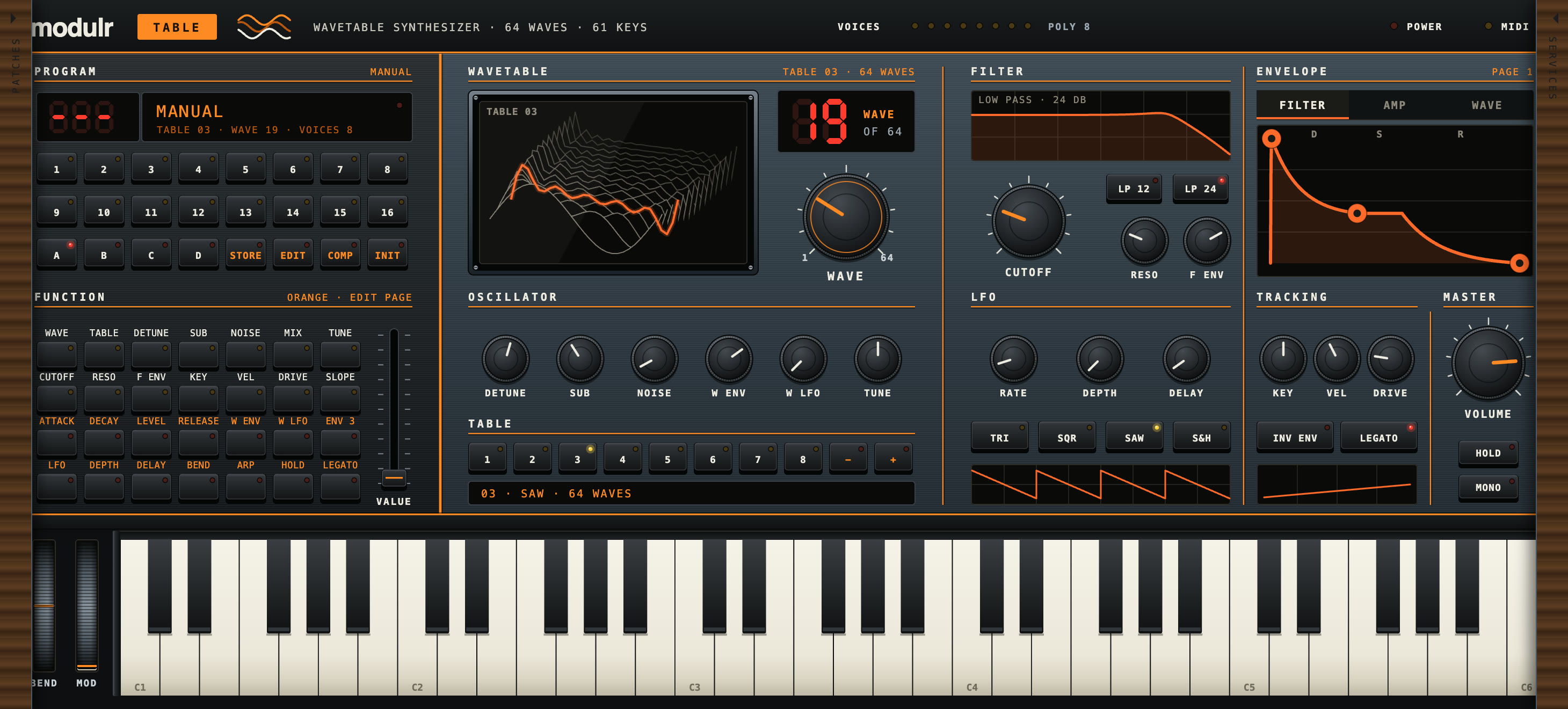
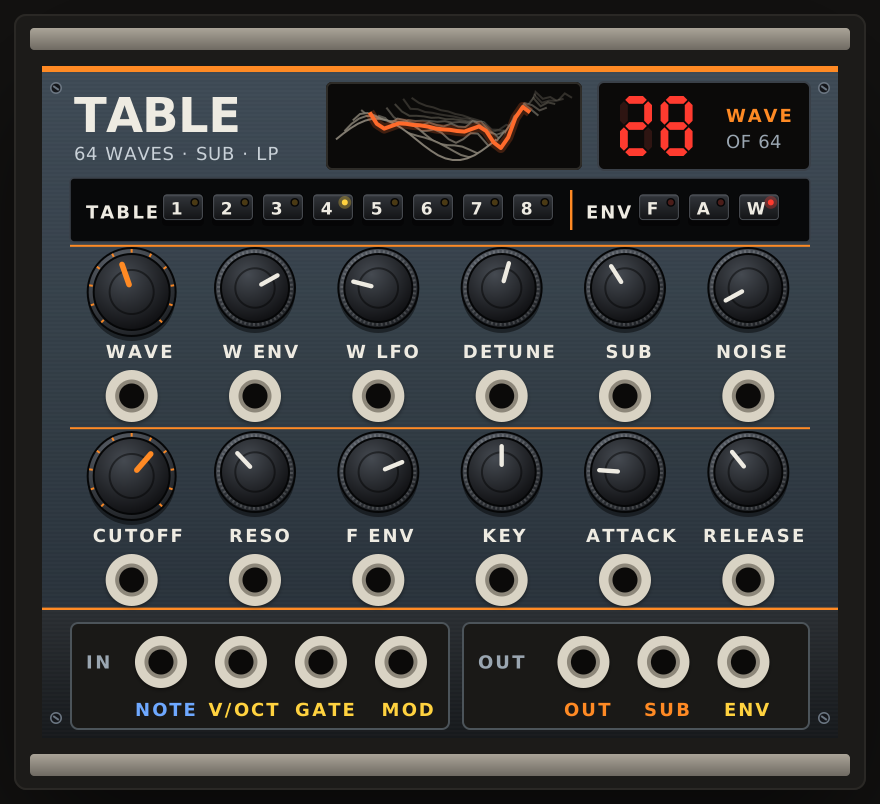
The editor is the plug-in’s own, as it opens. The module is drawn by the specification’s own kit, and its values are illustrative, not measured. The design is the PPG Wave’s grammar, redrawn in Modulr’s own words, and nothing on it is measured against the instrument.
PPG Wave 2.2, 1982.
The instrument’s own grammar, as the catalogue recalls it: the sections, the controls and the look the study borrows.
The wavetable grammar: a sweep through 64 waves chosen by one large knob and moved by its own envelope, a sub oscillator, a resonant low-pass with key follow, and a block of chunky black square keys with a tiny round LED in the corner of each.
One flat slate-and-charcoal metal panel divided by thin orange rules and white capitals, no cards: an orange bar across the top, a wave stack and a large red LED wave number, a strip of black square TABLE and ENV keys with round LEDs, twelve black knobs (Wave and Cutoff larger, with an orange scale) each with a CV jack under it, the jacks in two charcoal trays.
- A wavetable oscillator with a 64-wave table and a wave-select knob
- A sub-oscillator
- An analogue-style low-pass filter: cutoff, resonance, envelope, key follow
- Two envelope generators and an LFO
- A program and function key matrix
- A pair of large rotary controls for the wavetable and the filter
- A small display of the wave position
- 61 keys
The module, knob by knob.
The module is a design study and is not built. Its macros are the signature controls a player reaches for; in the plug-in every one of them is a knob or a key on the editor.
| Macro | Key | Range | Default |
|---|---|---|---|
| Wave | osc.wave | wave 1 – 64 | wave 1 |
| W Env | wave.env | ±100% | 0% |
| W LFO | wave.lfo | 0–100% | 0% |
| Detune | osc.detune | ±100 ct | 0 ct |
| Sub | sub.level | 0–100% | 0% |
| Noise | mix.noise | 0–100% | 0% |
| Cutoff | vcf.cut | 20 Hz – 20 kHz | 20 kHz |
| Reso | vcf.res | 0–100% | 0% |
| F Env | vcf.env | ±100% | 0% |
| Key | vcf.key | 0–100% | 0% |
| Attack | env.attack | 0 ms – 20.0 s | 5 ms |
| Release | env.release | 0 ms – 20.0 s | 200 ms |
| Side | Jacks |
|---|---|
| In | Note (MIDI), V/Oct (CV), Gate (CV), Mod (CV) |
| Out | Out (Audio), Sub (Audio), Env (CV) |
Legendary is the catalogue of the Modulr Synths project: 43 design studies drawn with the specification’s own kit, 33 after the synthesizers of all time and 10 after the drum machines. The makers and years named here are the instrument’s; the names, the layouts and every value are Modulr’s own.