Modulr Station
Eight parts, thirty-two waves, a display with a data slider, and a fader or key for every control, played from your keyboard as a VST3 and Audio Unit.
Modulr Station is a multitimbral workstation after the grammar of the 1988 M1: eight parts, each with one or two waves out of thirty-two that the engine synthesises, a low-pass filter and an amplitude envelope of its own, a reverb and a chorus, a joystick, and a large display with a data slider and a ten-key pad that reach every setting. Under the display every control also has a fader or a key of its own. It is a VST3 and Audio Unit plug-in.
Six sounds, played as they ship.
Each clip is the plug-in itself: a patch is picked in the drawer and loaded, then a played line sounds on it, the way it is played into the plug-in from a keyboard. The bank holds thirty-one patches that make six distinct sounds, one for each role; these are one of each. No effects added, no mastering.
The editor, and the module it becomes.
The plug-in is built, and its editor is shown playing a patch. The Eurorack module drawn beside it, with its macro knobs and the control jacks under them, is a design study and is not built.
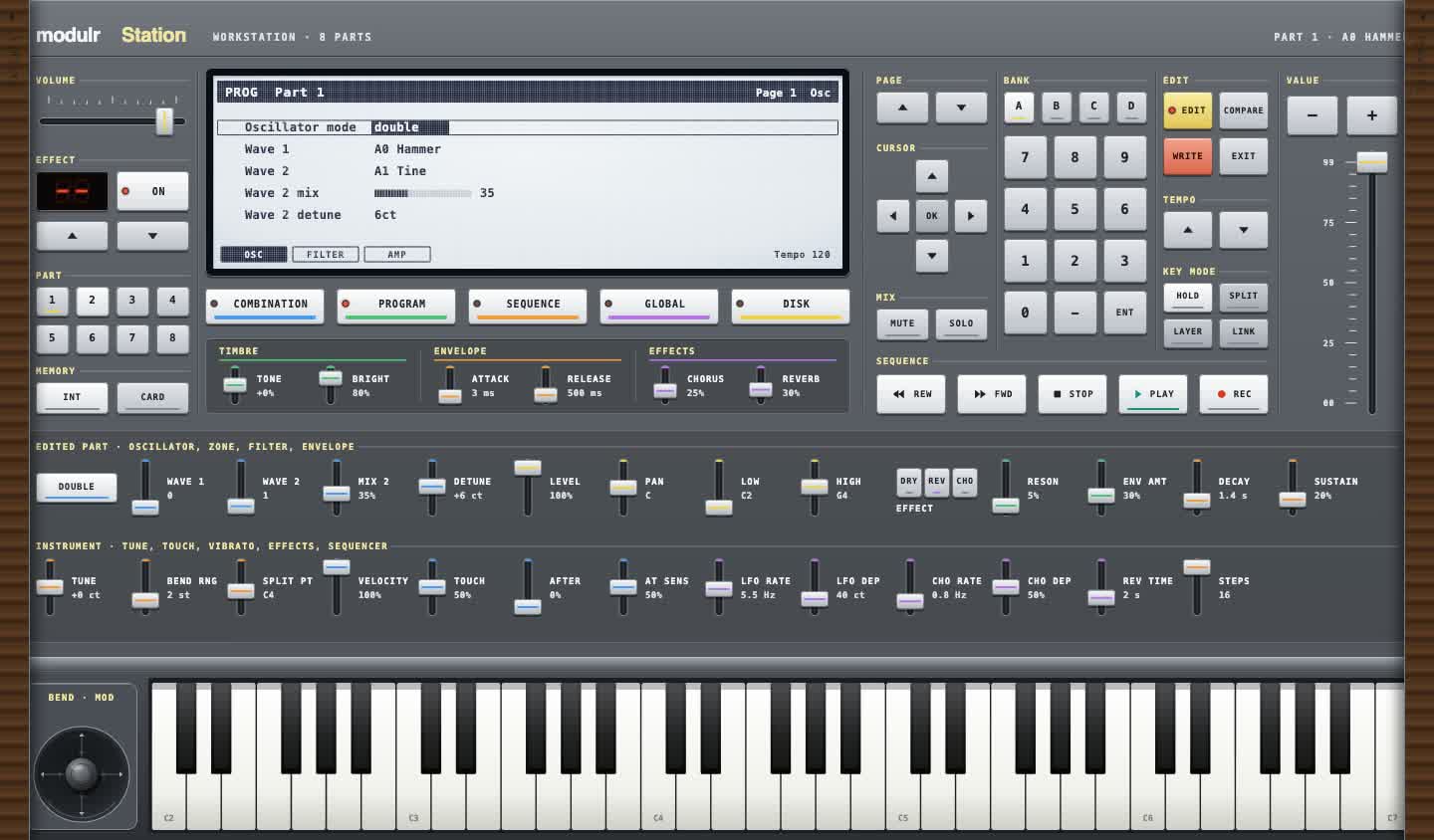
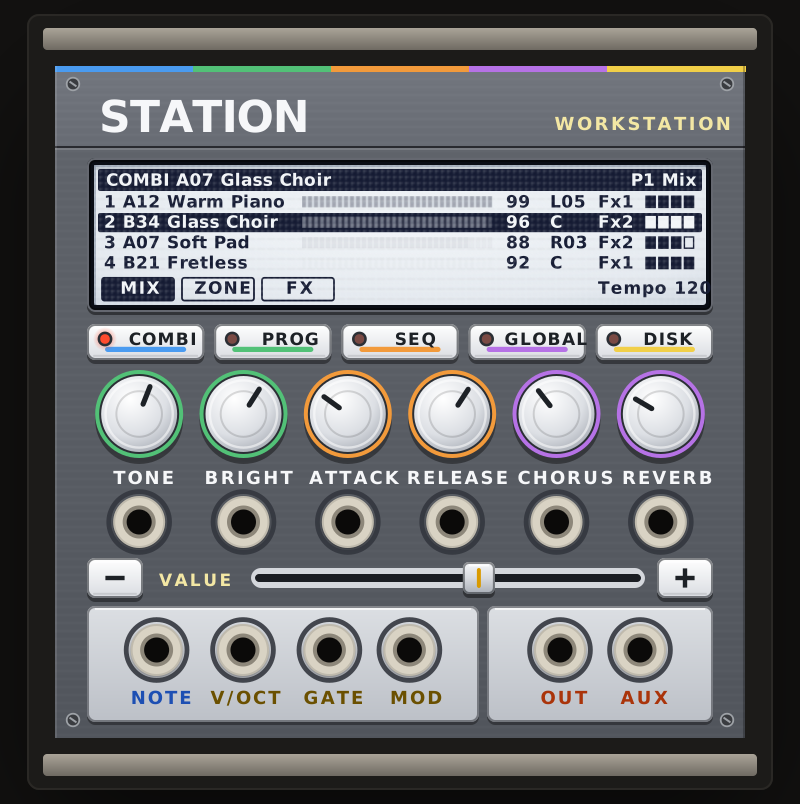
The editor is the plug-in’s own, captured as it plays. The module is drawn by the specification’s own kit, and its values are illustrative, not measured. The design is the M1’s grammar, redrawn in Modulr’s own words, and nothing on it is measured against the instrument.
M1, 1988.
The instrument’s own grammar, as the catalogue recalls it: the sections, the controls and the look the study borrows.
The sampled-ROM workstation grammar: one big LCD driven by colour-coded mode pads (combination, program, sequence, global, disk), page and cursor pads, a numeric pad with bank pads, one long data-entry slider with plus and minus, a joystick and eight multitimbral parts; every readout but one lives in the LCD.
A mid cool-grey workstation panel in 26 HP with a lighter top face: a pale grey-white backlit LCD in a black frame, five white mode pads each wearing its own colour bar, six ring-coloured knobs in light caps with a CV jack under each, a white slider with minus and plus, and light-grey jack trays with their labels tinted by kind.
- A large LCD
- Mode buttons: Combination, Program, Sequence, Global, Disk
- A page and cursor group
- A 10-key numeric pad and bank buttons
- A data-entry slider and plus and minus
- A joystick for pitch and mod
- A control group of master volume and effects select
- Eight-part multitimbral
The module, knob by knob.
The module is a design study and is not built. Its macros are the signature controls a player reaches for, not a generic set; each one has a control jack under it.
| Macro | Key | Range | Default |
|---|---|---|---|
| Tone | prog.tone | -100% – +100% | 0% |
| Bright | vcf.bright | 0–100% | 50% |
| Attack | env.attack | 1 ms – 4 s | 5 ms |
| Release | env.release | 10 ms – 8 s | 300 ms |
| Chorus | fx.chorus | 0–100% | 0% |
| Reverb | fx.reverb | 0–100% | 0% |
| Side | Jacks |
|---|---|
| In | Note (MIDI), V/Oct (CV), Gate (CV), Mod (CV) |
| Out | Out (Audio), Aux (Audio) |
Legendary is the catalogue of the Modulr Synths project: 43 design studies drawn with the specification’s own kit, 33 after the synthesizers of all time and 10 after the drum machines. The makers and years named here are the instrument’s; the names, the layouts and every value are Modulr’s own.