Modulr Clav
Twenty-four partials set by level and phase, a large display, and rows of numbered keys.
Modulr Clav is a synthesizer after the grammar of a 1977 additive workstation. A timbre of twenty-four partials with a level and a phase each, picked by numbered keys and set with one data knob, over a velocity and pressure keyboard; a tilt and an odd/even balance reshape the whole spectrum at once, and a recording sequencer keeps eight tracks of what you play. VST3 and Audio Unit.
Eight sounds, played as they ship.
Each clip is the plug-in itself: the patch is picked in the drawer and loaded, a short phrase is played on it, and the spectral tilt is swept over the take so the bars of the display lean toward the top and back. The patches are the instrument’s own recipes for additive sounds, written as a spectrum; none is a recording of any other instrument.
A spectrum you shape, then play.
- A timbre is twenty-four partials.Each sine has a level and a phase. Pick a partial with its numbered key, then set it with the data knob or draw the levels straight on the green display.
- Tilt and odd/even.One knob leans the whole spectrum toward the top or the bottom; another pulls the odd partials or the even ones toward silence, from a flute to a hollow reed.
- Patches that load the whole sound.Pick a patch and every level, phase and shaping control moves to it at once, and the display draws its spectrum; the drawer closes and the voice is ready.
- Hold to preview.Hold a key to hear a patch on your own MIDI, then let go and the instrument is exactly as it was.
- A sequencer of eight tracks.Record what you play as a layer of a track, add layers with Dub, take the last away with Undo, fold them with Merge, and loop the lot at a tempo with an optional click.
- Services.Choose whether the instrument answers your host’s MIDI and clock, set its output level, and age it: the decay shortens, the tuning drifts flat and the resonance rings less.
What it needs.
| Format | Systems | Licence |
|---|---|---|
| VST3 · Audio Unit | macOS 11 or later, on Apple silicon | A licence is needed to make sound. Without one the editor opens and the output is silent. |
The editor, and the module it becomes.
The plug-in is built. The Eurorack module is drawn, with its macro knobs and the control jacks under them, and is not.
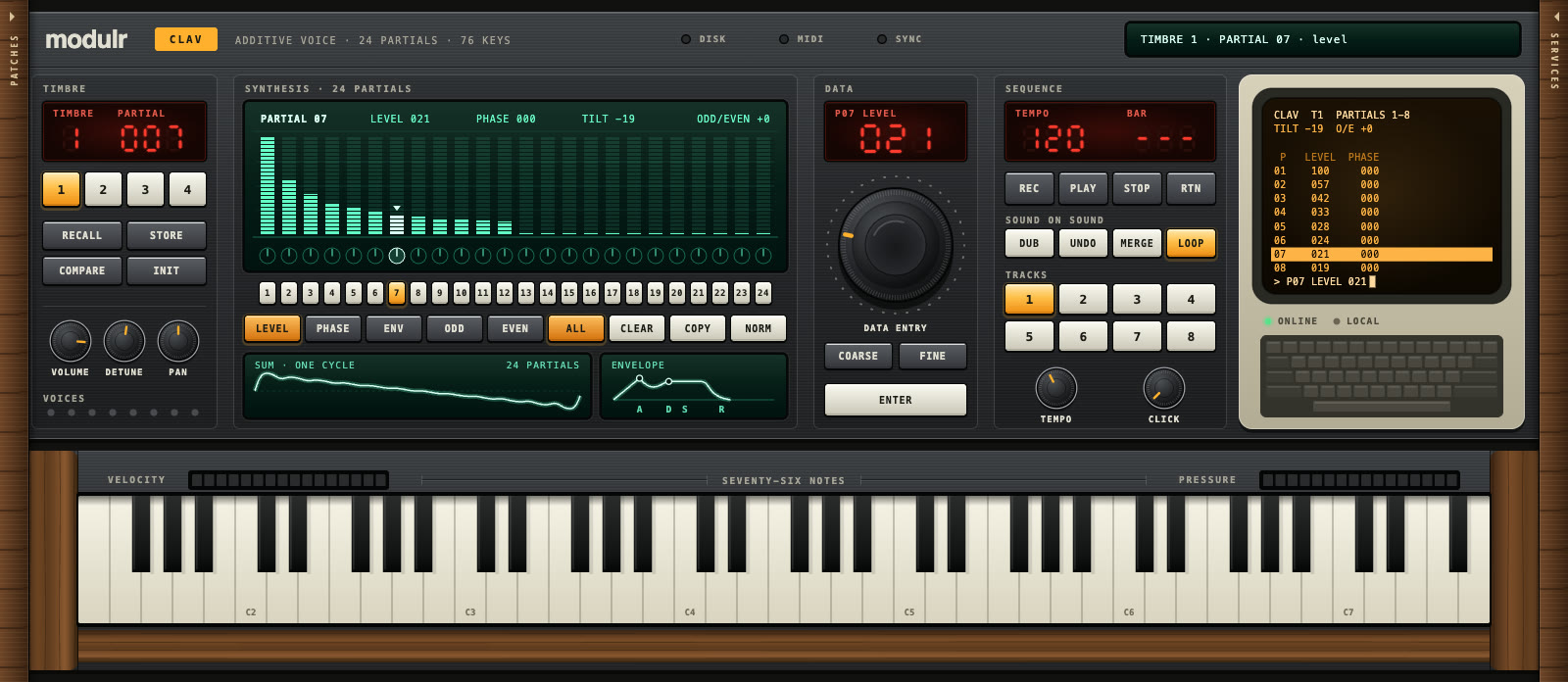
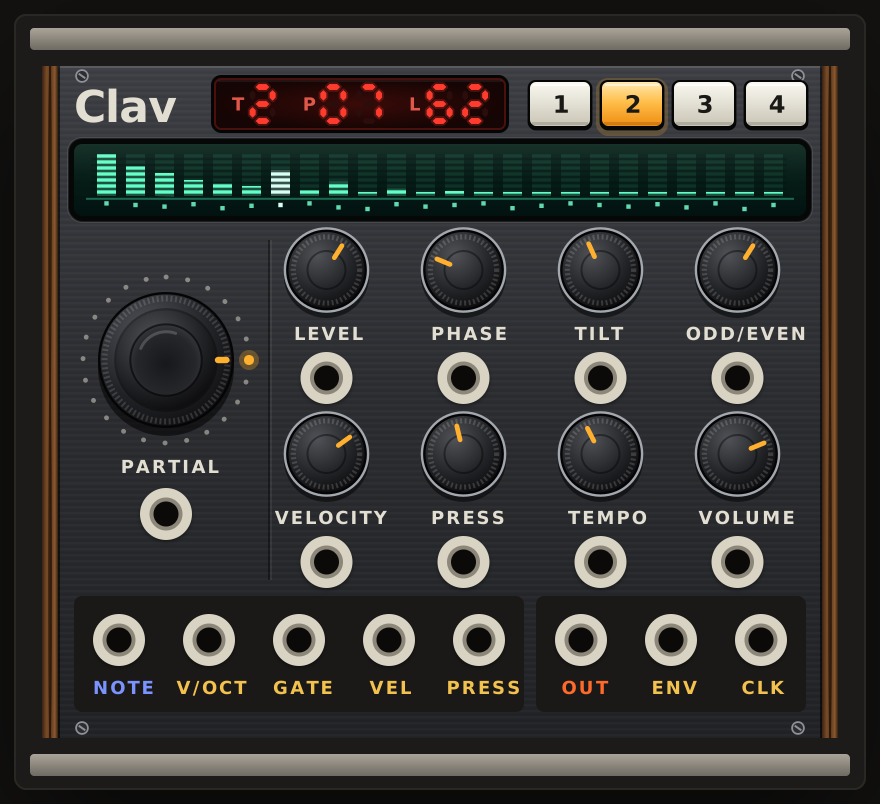
The editor is the plug-in’s own, as it opens. The module is drawn by the specification’s own kit, and its values are illustrative, not measured. The design is Synclavier’s grammar, redrawn in Modulr’s own words, and nothing on it is measured against the instrument.
Synclavier, 1977.
The instrument’s own grammar, as the catalogue recalls it: the sections, the controls and the look the study borrows.
The additive-workstation grammar: a timbre built from twenty-four partials with a level and a phase each, picked by numbered square keys and set with one big data knob, played from a keyboard that answers velocity and pressure, with a sequencer and sound-on-sound recording.
A dark gunmetal console in 30 HP between walnut end strips: a red LED read-out and four square timbre keys, a green display of twenty-four partial bars with a phase mark under each, one big fluted data encoder ringed by twenty-four detent dots, eight small fluted knobs beside it, a CV jack under each, and two dark jack trays.
- A control panel with a large digital knob and rows of numbered buttons
- A timbre selection by partials
- The synthesis section: 24 harmonic partials with level and phase
- The sound-on-sound and sample sequences
- A row of function buttons
- A large green display
- A computer terminal beside the panel
- A velocity and pressure keyboard
The module, knob by knob.
The module is a design study and is not built. Its macros are the signature controls a player reaches for, not a generic set; each one has a control jack under it.
| Macro | Key | Range | Default |
|---|---|---|---|
| Partial | add.partial | P01 – P24 | P01 |
| Level | add.level | 0–100% | 100% |
| Phase | add.phase | 0–360 deg | 0 deg |
| Tilt | add.tilt | -100% – +100% | 0% |
| Odd/Even | add.oddeven | -100% – +100% | 0% |
| Velocity | touch.velocity | 0–100% | 50% |
| Press | touch.pressure | 0–100% | 0% |
| Tempo | seq.tempo | 40–240 BPM | 120 BPM |
| Volume | out.volume | -inf – +6 dB | 0.0 dB |
| Side | Jacks |
|---|---|
| In | Note (MIDI), V/Oct (CV), Gate (CV), Vel (CV), Press (CV) |
| Out | Out (Audio), Env (CV), Clk (CV) |
Legendary is the catalogue of the Modulr Synths project: 43 design studies drawn with the specification’s own kit, 33 after the synthesizers of all time and 10 after the drum machines. The makers and years named here are the instrument’s; the names, the layouts and every value are Modulr’s own.