Modulr Linear
A tone of upper and lower partials, edited from a joystick and a membrane panel, in dual key mode.
Modulr Linear is a design study after the D-50 of 1987. It borrows the partial grammar: a tone is an upper and a lower layer of sampled and synthesised partials, edited from a display, a field of membrane buttons and a joystick, with chorus and reverb at the end.
The editor, and the module it becomes.
Each study is drawn twice: as a standalone plug-in editor, and as a Eurorack module with its macro knobs and the control jacks under them. Nothing here is built.
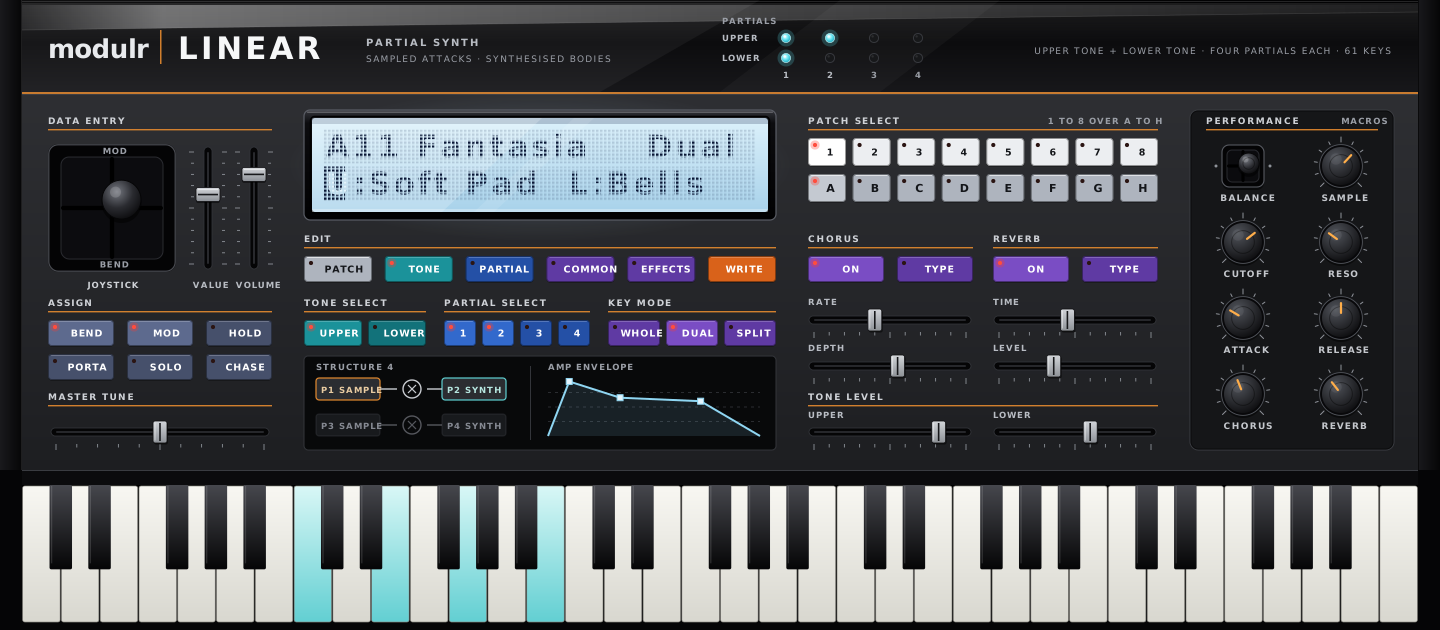
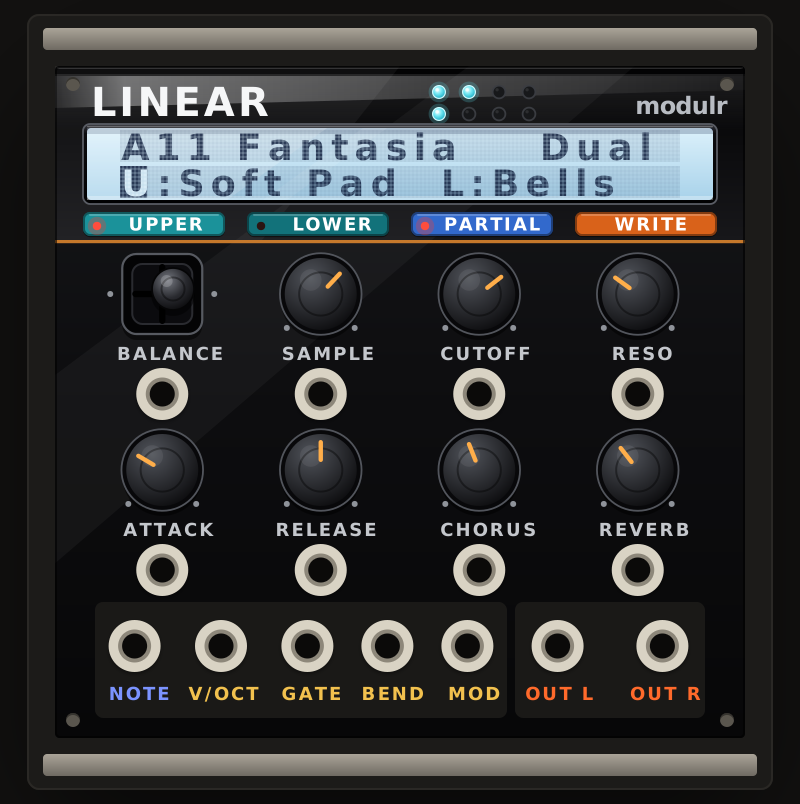
Mock UI — drawn by the specification’s own kit, not a screenshot of a shipped editor. Values are illustrative, not measured. The study is D-50’s grammar, redrawn in Modulr’s own words, and nothing on it is measured against the instrument.
D-50, 1987.
The instrument’s own grammar, as the catalogue recalls it: the sections, the controls and the look the study borrows.
The partial-synth grammar: a tone is upper and lower layers of sampled and synthesised partials, edited from a display and a field of membrane buttons (tone, partial, common), a joystick, a data slider, patch number over bank, and chorus and reverb at the end.
A glossy black face with a glare strip across the top: a two-line ice-blue dot-matrix display, a row of four flat coloured membrane pads (teal, blue, orange), a joystick-well balance cell and seven black knobs with an amber line, each over its CV jack, and the jacks in a dark tray.
- A two-line backlit LCD
- The structure of a tone: upper and lower partials, each a PCM sample or a synthesised wave
- The tone, partial and common parameter groups on buttons
- A joystick for data entry
- A long panel of membrane buttons: patch select 1 to 8 over bank A to H
- A slider for value
- A chorus and reverb effects section
- A 61-key keyboard with pitch and mod bend
The module, knob by knob.
The macros are the signature controls a player reaches for, not a generic set; each one has a control jack under it on the module.
| Macro | Key | Range | Default |
|---|---|---|---|
| Balance | tone.balance | lower only – upper only | U 50 · L 50 |
| Sample | partial.sample | 0–100% | 100% |
| Cutoff | tvf.cut | 20 Hz – 20 kHz | 20 kHz |
| Reso | tvf.res | 0–100% | 0% |
| Attack | tva.attack | 1 ms – 10 s | 5 ms |
| Release | tva.release | 1 ms – 10 s | 300 ms |
| Chorus | fx.chorus | 0–100% | 0% |
| Reverb | fx.reverb | 0–100% | 0% |
| Side | Jacks |
|---|---|
| In | Note (MIDI), V/Oct (CV), Gate (CV), Bend (CV), Mod (CV) |
| Out | Out L (Audio), Out R (Audio) |
Legendary is the catalogue of the Modulr Synths project: 43 design studies drawn with the specification’s own kit, 33 after the synthesizers of all time and 10 after the drum machines. The makers and years named here are the instrument’s; the names, the layouts and every value are Modulr’s own.