Modulr Page
A sampler with a light pen, a monitor for drawing waveforms, and two drives for the library.
Modulr Page is a design study after the Fairlight CMI of 1979. It borrows the sampling grammar: a monitor and a light pen in place of knobs, page keys on a typewriter keyboard, a library of sample slots, and a cycle drawn with the pen that morphs into its harmonics.
The editor, and the module it becomes.
Each study is drawn twice: as a standalone plug-in editor, and as a Eurorack module with its macro knobs and the control jacks under them. Nothing here is built.
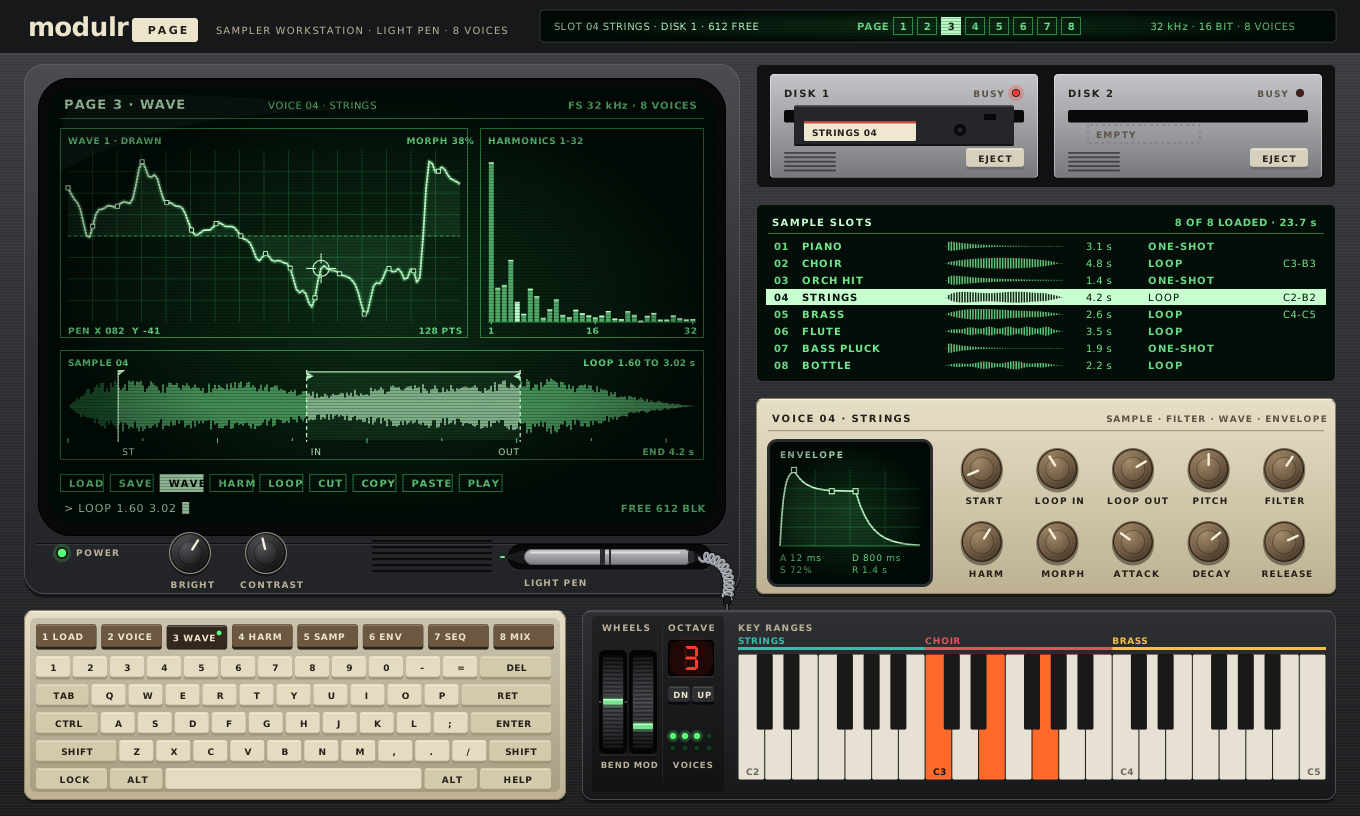
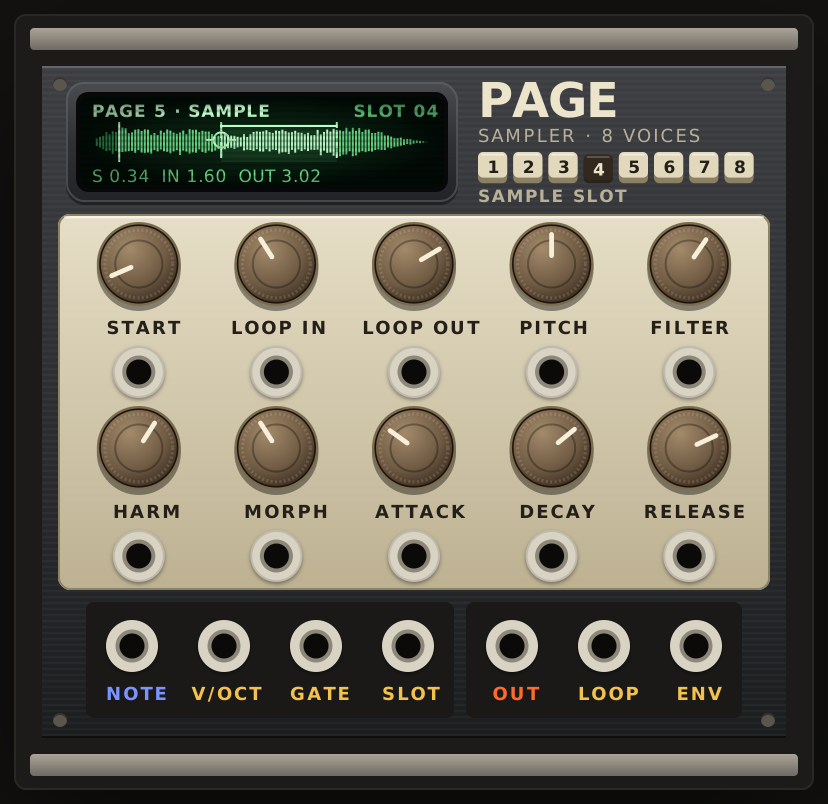
Mock UI — drawn by the specification’s own kit, not a screenshot of a shipped editor. Values are illustrative, not measured. The study is Fairlight CMI’s grammar, redrawn in Modulr’s own words, and nothing on it is measured against the instrument.
Fairlight CMI, 1979.
The instrument’s own grammar, as the catalogue recalls it: the sections, the controls and the look the study borrows.
The sampling-workstation grammar: a monitor and a light pen instead of knobs, page keys on a cream typewriter, a library of sample slots, a drawn cycle morphing into its harmonic set, and start, loop and release points on the whole sample.
A dark console in 28 HP: a small phosphor monitor in a grey bezel showing the sample with its loop markers beside the title and eight slot keys, a cream plate of ten brown-capped knobs with a CV jack under each, and two dark jack trays at the foot.
- A monitor showing the waveform drawn by the light pen, and the harmonic editor
- The page menu: the sequencer page and the sample-editing page, chosen by function keys
- A typewriter keyboard and a music keyboard
- Two floppy drives
- A light pen
- Sample slots, a library of sounds, with attack, decay and loop points
- A sampler voice with a start, loop, pitch, filter and envelope
The module, knob by knob.
The macros are the signature controls a player reaches for, not a generic set; each one has a control jack under it on the module.
| Macro | Key | Range | Default |
|---|---|---|---|
| Start | smp.start | 0 s – 4.2 s | 0.00 s |
| Loop in | smp.loopin | 0 s – 4.2 s | 0.00 s |
| Loop out | smp.loopout | 0 s – 4.2 s | 4.20 s |
| Pitch | smp.pitch | ±24 st | 0 st |
| Filter | vcf.cut | 80 Hz – 18 kHz | 18 kHz |
| Harm | wave.harm | −100% – +100% | 0% |
| Morph | wave.morph | 0–100% | 0% |
| Attack | env.attack | 1 ms – 4 s | 1 ms |
| Decay | env.decay | 5 ms – 8 s | 300 ms |
| Release | env.release | 5 ms – 10 s | 300 ms |
| Side | Jacks |
|---|---|
| In | Note (MIDI), V/Oct (CV), Gate (CV), Slot (CV) |
| Out | Out (Audio), Loop (CV), Env (CV) |
Legendary is the catalogue of the Modulr Synths project: 43 design studies drawn with the specification’s own kit, 33 after the synthesizers of all time and 10 after the drum machines. The makers and years named here are the instrument’s; the names, the layouts and every value are Modulr’s own.