Modulr Quint
Five voices of two oscillators each, a hard sync, poly-mod and wheel-mod, and a filter envelope and an amplifier envelope of their own, with forty-nine patches.
Modulr Quint is a five-voice polyphonic synthesizer after the grammar of a 1978 programmable polysynth: two oscillators a voice with a hard sync, a four-pole filter, two envelopes of four stages each, poly-mod and wheel-mod routings with a switch for each destination, an LFO, glide and unison. The programmer’s forty programs are drawn and inert: you choose the sound in the patch drawer.
Six sounds, played as they ship.
Each clip is the plug-in itself: a patch is picked in the drawer and loaded, then a played chord or line sounds on it, the way it is played into the plug-in from a keyboard. The forty-nine patches hold six distinct sounds, one for each clip here. No source documents a setting on the instrument these records were made on, so the artist-named patches are this product’s reading of each sound’s role, not the artist’s own setting.
Five voices, two oscillators each.
- Two oscillators a voice.Each a saw, a triangle and a pulse that sound together or alone, with a pulse width; the second has a fine tune, a low range and a key that frees it from the keyboard, and a hard sync to the first.
- A mixer and a filter.The two oscillators and a white noise, then a four-pole low-pass with resonance, an envelope amount and a keyboard tracking of a half or a whole octave.
- Two envelopes.A filter envelope and an amplifier envelope, each with attack, decay, sustain and release, and a release key that lets the amplifier ring on or cuts it off.
- Poly-mod.The filter envelope and the second oscillator, at their own amounts, sent to oscillator A’s pitch and pulse width, oscillator B’s, and the cutoff, behind a key for each destination.
- Wheel-mod and an LFO.A triangle, a saw or a square, mixed with noise by one knob and sent by the mod wheel to the same five destinations; the LFO’s initial amount sends it with the wheel at rest.
- Glide, unison and the wheels.A glide time, a unison that stacks all five voices on one key, a pitch wheel that springs back and a mod wheel that stays where you leave it.
- Patches that load the whole sound.Pick a patch and every control moves to it at once; the drawer closes and the keys are ready. Hold to preview plays a patch’s tone on your own MIDI, and when you let go the instrument is exactly as it was. The programmer’s keys are drawn and do nothing.
- Services.Choose whether the instrument answers your host’s MIDI and clock, set its output level, and age it.
What it needs.
| Format | Systems | Licence |
|---|---|---|
| VST3 · Audio Unit | macOS 11 or later, on Apple silicon | $25. A licence file for each machine is needed to make sound; without one the editor opens and the output is silent, and there is no automatic way yet to receive one. |
The editor, and the module it becomes.
The plug-in is built. The Eurorack module is drawn, with its macro knobs and the control jacks under them, and is not.
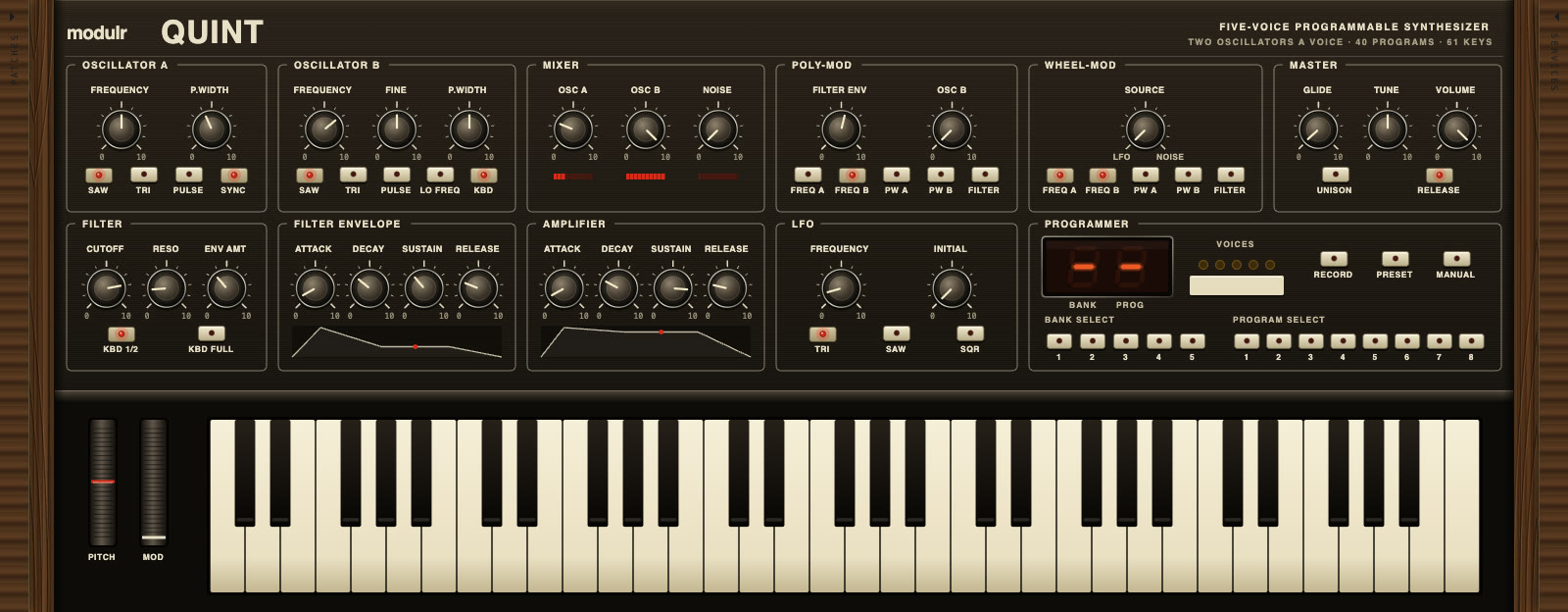
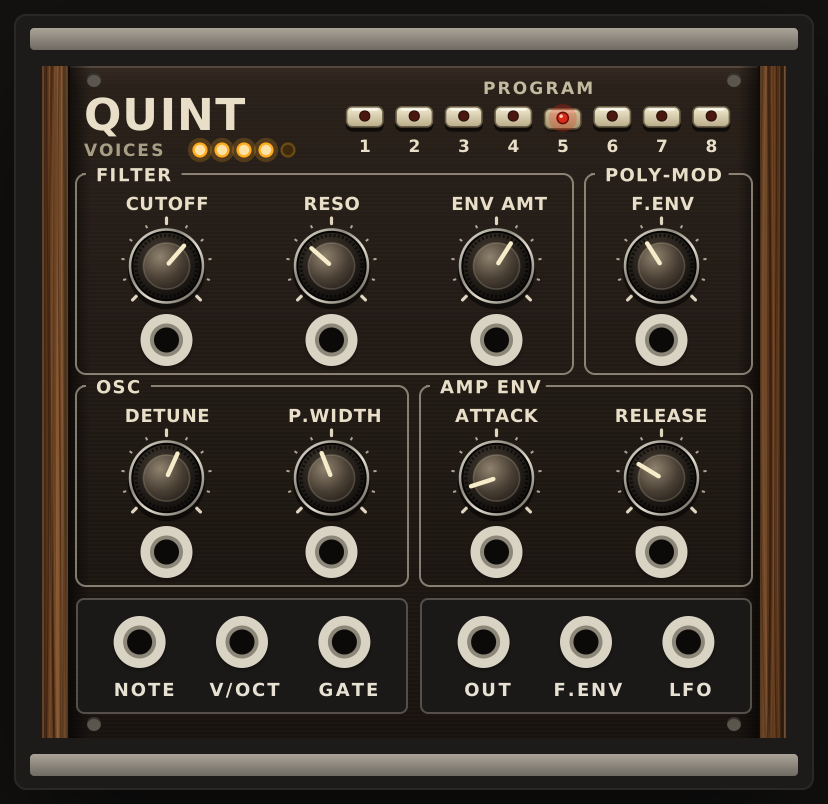
The editor is the plug-in’s own, as it opens. The module is drawn by the specification’s own kit, and its values are illustrative, not measured. The design is the Prophet-5’s grammar, redrawn in Modulr’s own words, and nothing on it is measured against the instrument.
Prophet-5, 1978.
The instrument’s own grammar, as the catalogue recalls it: the sections, the controls and the look the study borrows.
The five-voice programmable polyphonic grammar: two oscillators with shape caps, a mixer, poly-mod and wheel-mod with their destination caps, a filter and two ADSR envelopes, an LFO and a programmer of five banks by eight programs.
A warm brown-black panel with cream silkscreen between thick walnut cheeks: small knobs with a chrome bezel and an ivory pointer line, ivory push caps over deep red lamps, five amber voice lamps and a dim red-orange two-digit program display.
- Oscillator A and B: frequency, shape switches for sawtooth, triangle and pulse, pulse width, sync and fine tune on B
- Mixer: A, B and noise
- Poly-Mod: the filter envelope and oscillator B as sources, with their destinations
- Wheel-Mod: a source mix of noise and LFO, with destinations
- Filter: cutoff, resonance, envelope amount and keyboard tracking
- Filter envelope: attack, decay, sustain and release; the amplifier envelope
- LFO: frequency, shape and initial amount
- Programmer: 40 programs on bank and program buttons, with tune and volume
The module, knob by knob.
The module is a design study and is not built. Its macros are the signature controls a player reaches for, not a generic set; each one has a control jack under it.
| Macro | Key | Range | Default |
|---|---|---|---|
| Cutoff | vcf.cut | 20 Hz – 20 kHz | 20 kHz |
| Reso | vcf.res | 0–100% | 0% |
| Env amt | vcf.env | 0–100% | 0% |
| Poly-Mod | pmod.fenv | 0–100% | 0% |
| Detune | oscb.fine | ±50 ct | 0 ct |
| P.Width | osca.pw | 5–95% | 50% |
| Attack | amp.attack | 0 ms – 20 s | 5 ms |
| Release | amp.release | 0 ms – 20 s | 200 ms |
| Side | Jacks |
|---|---|
| In | Note (MIDI), V/Oct (CV), Gate (CV) |
| Out | Out (Audio), F.Env (CV), LFO (CV) |
Legendary is the catalogue of the Modulr Synths project: 43 design studies drawn with the specification’s own kit, 33 after the synthesizers of all time and 10 after the drum machines. The makers and years named here are the instrument’s; the names, the layouts and every value are Modulr’s own.