Modulr Operator
Six operators, thirty-two algorithms and four-rate envelopes, edited from a slider and a membrane panel, over fifty patches.
Modulr Operator is a sixteen-voice polyphonic FM synthesizer after the grammar of a 1983 six-operator instrument: six sine operators joined by thirty-two algorithms, four-rate envelopes, a pitch envelope and an LFO, edited from a panel of membrane keys and one slider. It is a VST3 and Audio Unit, with fifty patches named for the records they are after.
Six sounds, played as they ship.
Each clip is the plug-in itself: the patch is picked in the drawer and loaded, a short phrase is played on it, and nothing else is touched. Each patch is named for a record it is after; its settings are Modulr’s reading of the sound’s role, not the artist’s own, and a studio sighting plays the voice as built. The sound is the instrument’s own output, with no effects and no mastering.
Six operators, edited from a menu.
- Six sine operators.Each with its own ratio, detune, level, key scaling and four-rate, four-level envelope, and its own on key; the select keys choose the operator the panel edits.
- Thirty-two algorithms.Click the algorithm chart to choose how the operators modulate one another, and set the feedback of the one operator that feeds itself.
- Edited by menu.A voice or function key chooses a parameter, the LCD names it and its value, and the data-entry slider and the minus and plus keys edit it. The Initial key puts every control back to where it started.
- A pitch envelope and an LFO.A four-rate, four-level pitch envelope, and an LFO with a wave, speed, delay, pitch depth and amplitude depth, with the modulation wheel routed where you choose.
- Patches.Fifty patches, each named for a record it is after. Thirty load a tone of their own; twenty are studio sightings that play the voice as built. Hold to preview plays a patch’s tone on your own MIDI, and when you let go the instrument is exactly as it was.
- Services.Choose whether the instrument answers your host’s MIDI and clock, set its output level, and age it: the decay shortens, the tuning drifts flat and the resonance rings less.
What it needs.
| Format | Systems | Licence |
|---|---|---|
| VST3 · Audio Unit | macOS 11 or later, on Apple silicon | A licence is needed to make sound. Without one the editor opens and the output is silent. |
The editor, and the module it becomes.
The plug-in is built. The Eurorack module is drawn, with its macro knobs and the control jacks under them, and is not built.
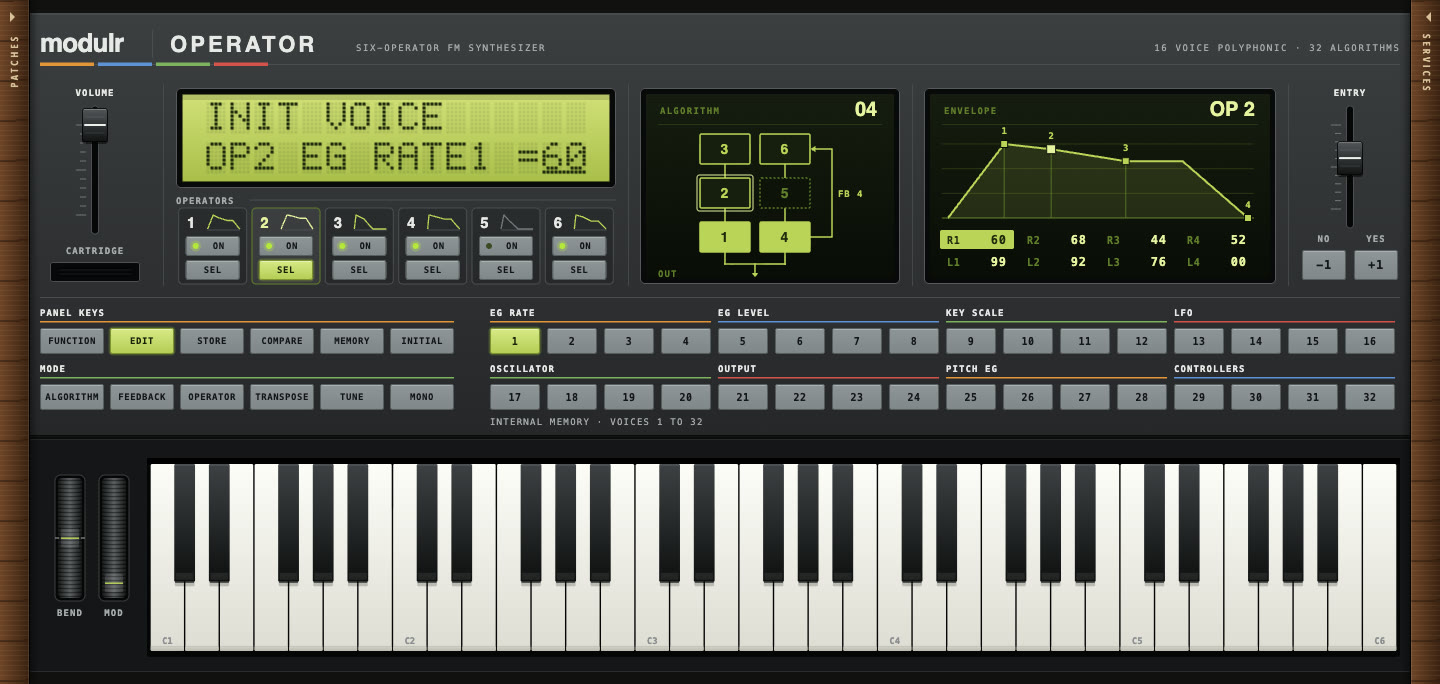
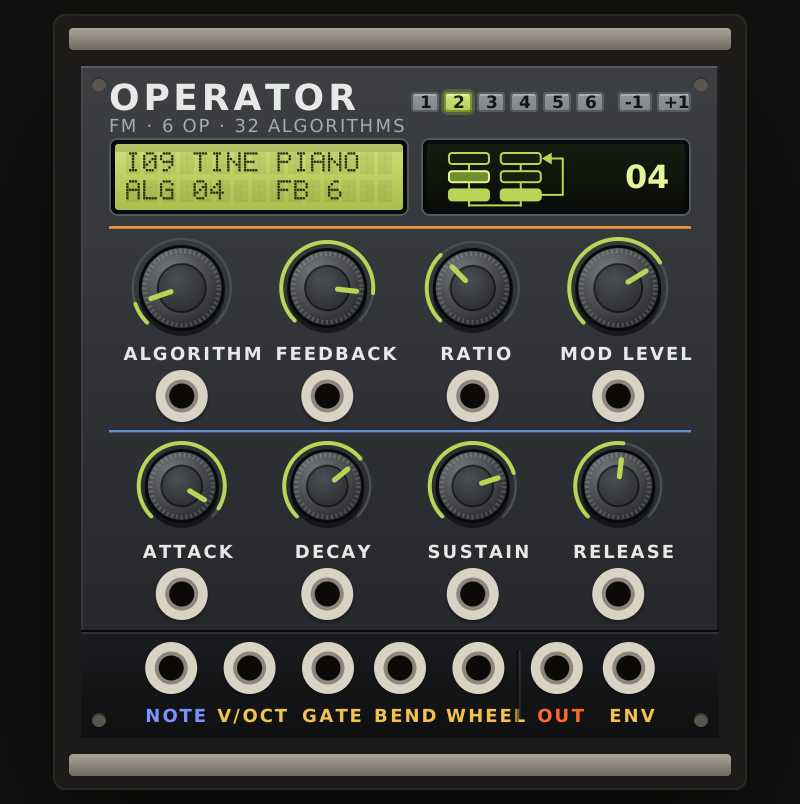
The editor is the plug-in’s own, as it opens. The module is drawn by the specification’s own kit, and its values are illustrative, not measured. The design is the DX7’s grammar, redrawn in Modulr’s own words, and nothing on it is measured against the instrument.
DX7, 1983.
The instrument’s own grammar, as the catalogue recalls it: the sections, the controls and the look the study borrows.
The six-operator FM grammar: flat grey membrane keys under small colour-coded legends, an LCD and an algorithm chart of operator boxes with the feedback loop marked, and a four-rate, four-level envelope edited with one entry slider.
A charcoal slab with a yellow-green dot-matrix LCD, a small algorithm diagram and a strip of flat grey operator keys on top, eight matte-grey knobs with a lime pointer and a CV jack under each, and a dark jack bar at the foot.
- Two-line LCD
- Six operators: each with an on/off and a select button
- Algorithm diagram: boxes of operators joined by lines, with feedback marked
- Envelope displays: four rates and four levels per operator
- Membrane function buttons in a grid, and 32 voice buttons in two rows
- Data-entry slider with plus and minus buttons
- Master volume
- Keyboard: 61 keys with pitch and mod wheels
The module, knob by knob.
The module is a design study and is not built. Its macros are the signature controls a player reaches for, not a generic set; each one has a control jack under it on the module.
| Macro | Key | Range | Default |
|---|---|---|---|
| Algorithm | alg.sel | 1–32 | 01 |
| Feedback | alg.fb | 0–7 | 0 |
| Ratio | op.ratio | 0.50 – 31.00 | 1.00 |
| Mod level | op.level | 0–99 | 99 |
| Attack | eg.r1 | 0–99 | 99 |
| Decay | eg.r2 | 0–99 | 99 |
| Sustain | eg.l3 | 0–99 | 99 |
| Release | eg.r4 | 0–99 | 50 |
| Side | Jacks |
|---|---|
| In | Note (MIDI), V/Oct (CV), Gate (CV), Bend (CV), Wheel (CV) |
| Out | Out (Audio), Env (CV) |
Legendary is the catalogue of the Modulr Synths project: 43 design studies drawn with the specification’s own kit, 33 after the synthesizers of all time and 10 after the drum machines. The makers and years named here are the instrument’s; the names, the layouts and every value are Modulr’s own.