Modulr Strain
Two oscillators and a sub, two filters with four routings, a five-slot modulation matrix, three LFOs and twelve voices.
Modulr Strain is a twelve-voice virtual-analog synthesizer after the grammar of the Virus (Access, 1997): two oscillators and a sub with a noise, a mixer, two filters in series, in parallel or split with a saturation between them, two envelopes, three LFOs, a chorus and a delay, a twin mode, a portamento, an arpeggiator and a five-slot modulation matrix. It is a VST3 and Audio Unit plug-in, and every control is automatable from the host.
Five sounds, played as they ship.
Each clip is the plug-in itself: a patch is picked in the drawer and loaded, then a played chord or line sounds on it, the way it is played into the plug-in from a keyboard. The bank holds fifty-three patches and five distinct sounds; these are those five. No effects, no mastering.
Twelve voices, two oscillators and two filters.
- Two oscillators and a sub.Each oscillator chooses from sixty-four waves and bends its shape, with a pulse width of its own; the second is detuned, can sync to the first and takes a phase modulation from it. The sub is a square or a triangle an octave under the first, and a noise sits beside them.
- A mixer.The balance between the two oscillators, their volume, which pushes the saturation as it rises, the sub and the noise.
- Two filters.Each a low-pass, high-pass, band-pass or band-stop with its own cutoff, resonance, envelope amount and key follow, joined in series of four poles or six, in parallel, or split with the first oscillator and the sub to one and the second and the noise to the other, with a saturation of five kinds between them.
- Two envelopes and three LFOs.An attack, decay, sustain, sustain time and release for the filter and for the amplifier; three LFOs of six waves, one for pitch, pulse width and resonance, one for shape, FM, the cutoffs and the pan, one for the vibrato on either or both oscillators or their pulse widths.
- Five matrix slots.LFO 1 to the first cutoff, LFO 2 to the second oscillator’s shape, the amplifier envelope to the first oscillator’s shape, the mod wheel to the FM amount, and the key’s velocity to the first resonance; each a small knob at the end of its bar.
- Chorus, delay, twin mode, portamento and an arpeggiator.A chorus and a delay of up to two thirds of a second, a twin mode that doubles every key detuned and spread, a glide between keys, and an arpeggiator that walks the held keys up, down, up and down or as played, over a chosen number of octaves on the clock.
- Patches that load the whole sound.Pick a patch and every control moves to it at once; the drawer closes and the keys are ready. Hold to preview plays a patch’s tone on your own MIDI, and when you let go the instrument is put back.
- Services.Choose whether the instrument answers your host’s MIDI and clock, set its output level, and age it.
What it needs.
| Format | Systems | Licence |
|---|---|---|
| VST3 · Audio Unit | macOS 11 or later, on Apple silicon | A licence is needed to make sound. Without one the editor opens and the output is silent. |
The editor, and the module it becomes.
The plug-in is built. The Eurorack module drawn beside it, with its macro knobs and the control jacks under them, is a design study and is not.
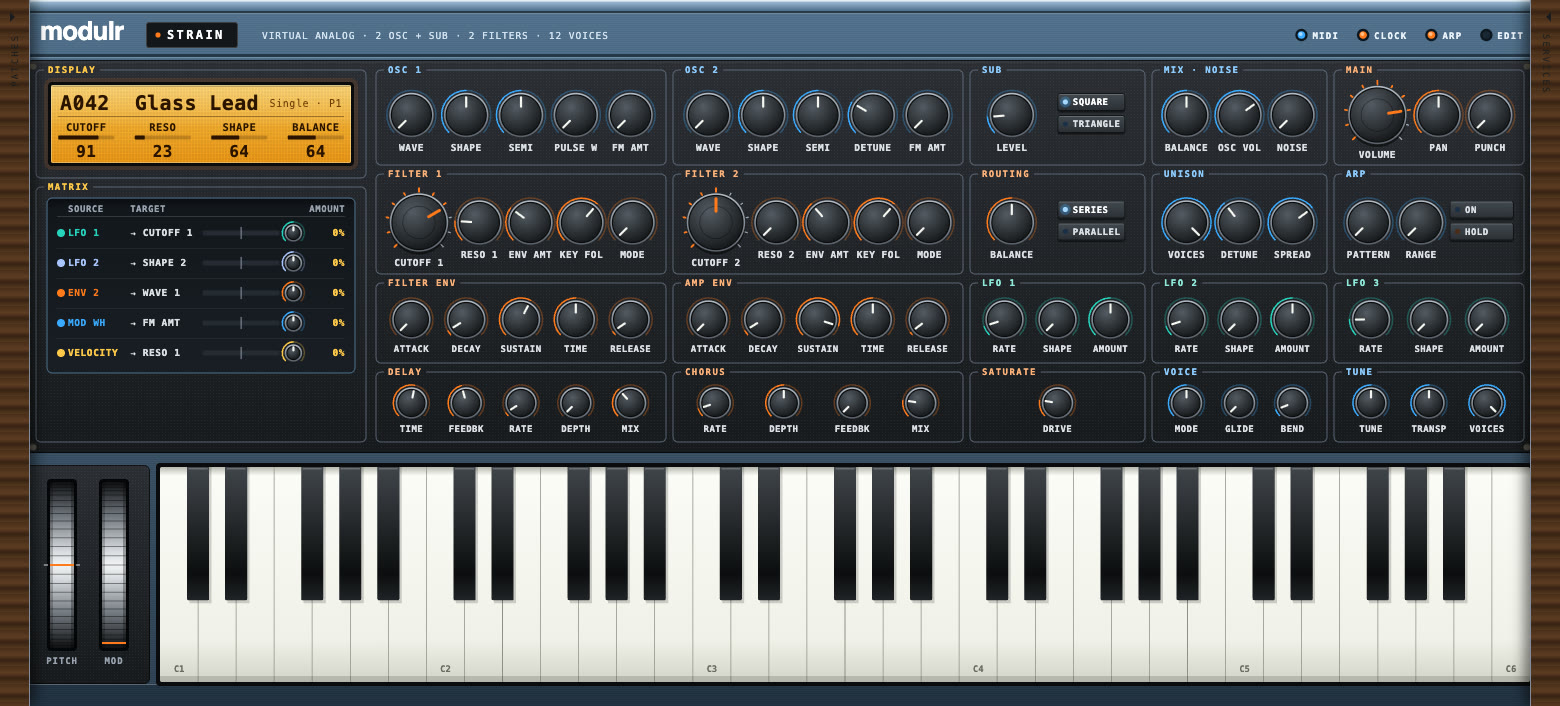
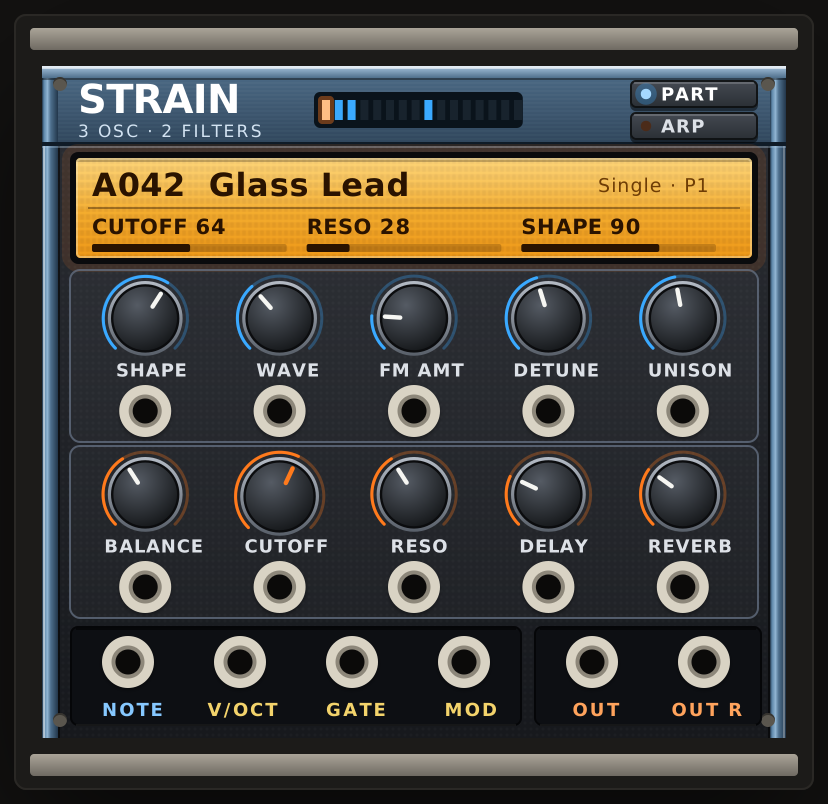
The editor is the plug-in’s own, playing a patch. The module is drawn by the specification’s own kit, and its values are illustrative, not measured. The design is the Virus’s grammar, redrawn in Modulr’s own words, and nothing on it is measured against the instrument.
Virus, 1997.
The instrument’s own grammar, as the catalogue recalls it: the sections, the controls and the look the study borrows.
The performance-synth grammar: three oscillators and a sub with shape and wave select, two filters with a balance and a routing mode, soft knobs under a two-line display, and one dense field of small knobs in outlined blocks with orange and blue LEDs.
A cool steel blue-grey chassis with a dark charcoal top: lipped blue-grey head band and metallic cheeks, a large bright amber two-line LCD with its Part and Arp keys, ten small black knobs in two outlined rows (blue and orange ring arcs) with a CV jack under each, and two dark jack trays at the foot.
- Three oscillators and a sub: wave select, shape morphing, pulse width, FM, sync and detune
- Two filters with a routing mode (series, parallel)
- The modulation matrix
- LFOs and envelopes
- Four soft knobs under a two-line display of parameter pages
- Effects: delay, chorus, reverb, distortion and phaser
- The arpeggiator
- A pitch wheel, a mod wheel and 61 keys
The module, knob by knob.
The macros are the signature controls a player reaches for, not a generic set; each one has a control jack under it on the module.
| Macro | Key | Range | Default |
|---|---|---|---|
| Shape | osc1.shape | 0–100% | 0% |
| Wave | osc1.wave | Wave 1 – 64 | Wave 1 |
| FM Amt | osc1.fm | 0–100% | 0% |
| Detune | osc2.det | ±50 ct | 0 ct |
| Unison | uni.det | 0–100% | 0% |
| Balance | vcf.bal | 0–100% (filter 1 to filter 2) | 50% |
| Cutoff | vcf.cut | 20 Hz – 20 kHz | 2.5 kHz |
| Reso | vcf.res | 0–100% | 0% |
| Delay | fx.dly.mix | 0–100% | 0% |
| Reverb | fx.rev.mix | 0–100% | 0% |
| Side | Jacks |
|---|---|
| In | Note (MIDI), V/Oct (CV), Gate (CV), Mod (CV) |
| Out | Out (Audio), Out R (Audio) |
Legendary is the catalogue of the Modulr Synths project: 43 design studies drawn with the specification’s own kit, 33 after the synthesizers of all time and 10 after the drum machines. The makers and years named here are the instrument’s; the names, the layouts and every value are Modulr’s own.