Modulr Mono
One control per function: two oscillators, a sub and noise, a resonant filter, an envelope each for the filter and the level, a glide and a sixteen-step sequencer, played from your keyboard as a VST3 and Audio Unit.
Modulr Mono is a bass and lead synthesizer after the grammar of the 2014 Sub 37: two oscillators, a sub an octave below and noise into a four-level mix, a resonant filter with its envelope amount, modulation and key tracking, an envelope each for the filter and the level, a glide with legato and three laws, a modulation oscillator with a delay, a bender with two depths and a sixteen-step pitch sequencer, on one graphite panel between walnut cheeks. It plays one voice, or up to eight. It is not a copy of any instrument: no maker’s name or logo is drawn on it, and nothing is measured against the original.
Thirteen sounds, played as they ship.
Each clip is the plug-in itself: the patch is picked in the drawer and loaded, the same short phrase is played on it (held chords on the last), and the cutoff is swept over the take. Twelve are after a record or a performance, and their settings are the plug-in’s own reading of that sound’s role, not the artist’s; the last is the instrument’s own setting. The three sequence patches carry a sixteen-step line of their own that plays with your host’s transport; the clips play the phrase instead, so the sounds can be heard side by side. 31 patches ship; they make thirteen distinct sounds, and these are one of each.
A bass and lead synthesizer, played from your keyboard.
- Patches that load the whole sound.Pick a patch and every control moves to it at once; the drawer closes and the instrument is ready to play. The three sequence patches also load a sixteen-step line, which plays when your host does.
- Hold to preview.Hold the drawer’s preview button to hear a patch’s tone on your own MIDI; let go and the instrument is exactly as it was.
- Two oscillators.The first with a continuous wave, saw and pulse switches, and a pulse width set by hand or swung by the modulation oscillator; the second with its own wave, an octave from 32′ to 2′ and a fine tune.
- A mixer of four.The two oscillators, a sub an octave below the first, and noise.
- A resonant filter and two envelopes.Cutoff and resonance, with the filter envelope’s amount and polarity, the modulation oscillator’s amount and key tracking. The filter has its own attack, decay, sustain and release, and the level its own, or the level follows the key in Gate mode.
- Glide.A key glides from the pitch of the key before over the glide’s time: from any key, or with Legato only from one still held; at a constant rate, in a constant time, or exponentially.
- A modulation oscillator.A rate, a depth and a delay, restarted by each key or left running; the mod wheel brings its depth in by hand.
- The bender and the keys.A bender that moves the pitch and the cutoff by depths of their own and springs back when you let go, an octave switch, transpose and hold.
- One voice, or up to eight.The bass, lead and sequence patches play one voice and the duo patch two; the instrument opens on six, and the Voices switch sets any number from one to eight.
- A sixteen-step pitch sequencer.Click a step on the pitch lane and set its note on the pitch keys, move it an octave, make it a rest or clear the line; Run plays it with your host’s transport, or free at its own tempo, over 8 or 16 steps.
- It draws what you hear.The two oscillators, the mix, the filter’s response, both envelopes and the modulation are drawn from the settings as they stand.
- Services.Choose whether the instrument answers your host’s MIDI and clock, set its output level, and age it.
What it needs.
| Format | Systems | Licence |
|---|---|---|
| VST3 · Audio Unit | Apple silicon, macOS 11 or later | A licence is needed to make sound. Without one the editor opens and the output is silent. |
The editor, and the module it becomes.
The plug-in is built, and its editor is shown playing a patch. The module is the same study drawn as a Eurorack module with its macro knobs and the control jacks under them, and it is not built.
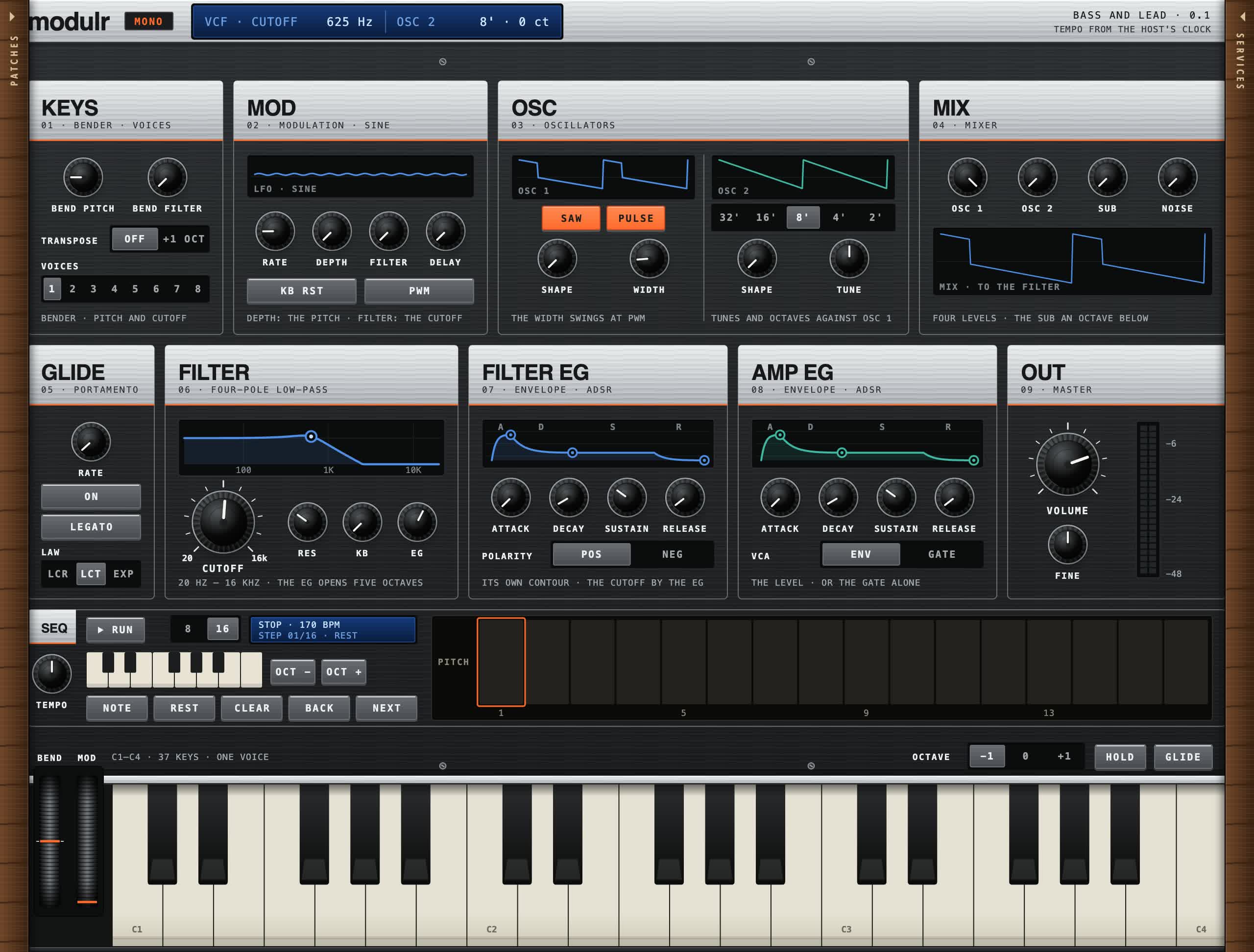
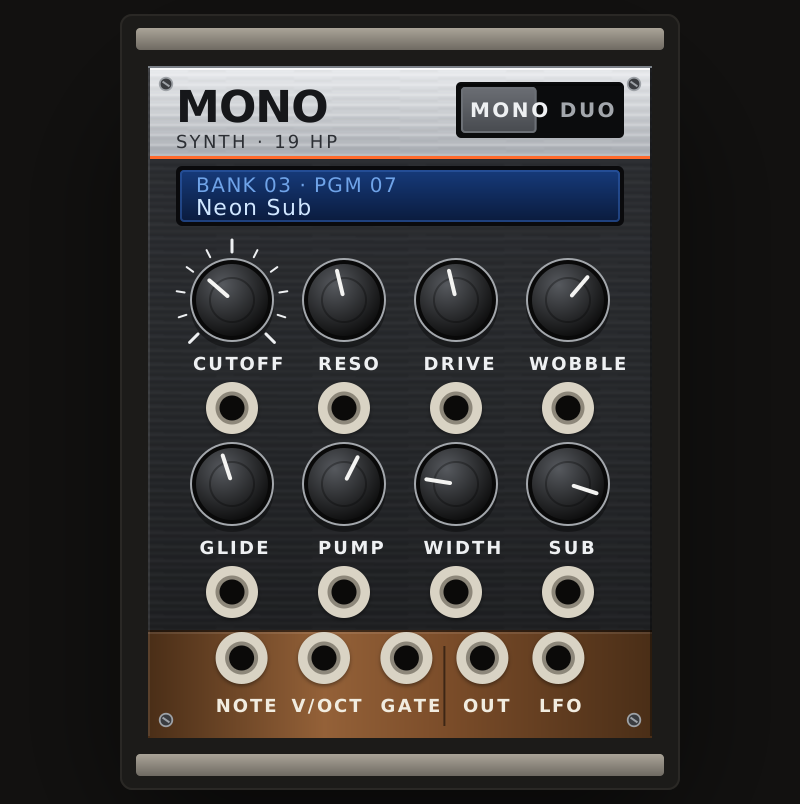
The editor is the plug-in’s own, captured as it plays. The module is drawn by the specification’s own kit, and its values are illustrative, not measured. The design is Sub 37’s grammar, redrawn in Modulr’s own words, and nothing on it is measured against the instrument.
Sub 37, 2014.
The instrument’s own grammar, as the catalogue recalls it: the sections, the controls and the look the study borrows.
One control per function on one panel: two oscillators with a continuous wave and a sub, a ladder filter with a selectable slope and Multidrive, two envelopes, two modulation busses, glide, Duo mode and a full-length 37-key strip.
Deep graphite metal with white print between brushed-silver rails, header bars and bezel, an orange rule under every title, walnut cheeks and a walnut jack bar, a blue LCD showing the program, black knobs with a white pointer line and Cutoff’s scale printed round it, and a Mono or Duo slide switch.
- Program: a blue LCD, the program and fine-tune knobs, Bank, Pgm and Save
- Mod 1 and Mod 2: two modulation busses, each with a rate, a pitch, a filter amount and a third destination
- Oscillators: two with a continuous wave and an octave, the second with frequency and beat, and hard sync
- Mixer: five channels for Osc 1, Osc 2, Sub, Noise and FB/Ext
- Glide: rate, on, legato and the law
- Filter: a ladder with a selectable slope, Multidrive, resonance and keyboard tracking
- Filter EG and Amp EG: two DAHDSR envelopes
- Output: volume, width, the meter and the host-synced pump
The module, knob by knob.
The module is a design study and is not built. Its macros are the signature controls a player reaches for, not a generic set; each one has a control jack under it.
| Macro | Key | Range | Default |
|---|---|---|---|
| Cutoff | vcf.cut | 20 Hz – 20 kHz | 20 kHz |
| Reso | vcf.res | 0–100% | 0% |
| Drive | vcf.drive | 0–100% | 0% |
| Wobble | mod1.filter | ±100% | 0% |
| Glide | glide.rate | 1 ms – 5.0 s | 50 ms |
| Pump | pump.depth | 0–100% | 0% |
| Width | out.width | 0–100% | 0% |
| Sub | mix.sub | 0–100% | 0% |
| Side | Jacks |
|---|---|
| In | Note (MIDI), V/Oct (CV), Gate (CV) |
| Out | Out (Audio), LFO (CV) |
Legendary is the catalogue of the Modulr Synths project: 43 design studies drawn with the specification’s own kit, 33 after the synthesizers of all time and 10 after the drum machines. The makers and years named here are the instrument’s; the names, the layouts and every value are Modulr’s own.