Modulr Dust
A floppy of twelve-bit samples, a start, a tune, a level and a decay for each, and a phone amplifier for the trigger.
Modulr Dust is a sampling drum machine after the grammar of a 1987 classic. Twenty-six sources on a disk, a knob for each voice parameter, a grid of source buttons, a sixteen-step phrase sequencer and an output mixer with a phone amplifier. Twelve patches, each loading a whole kit and phrase at once.
16 kits, played as they ship.
Each clip is the plug-in itself: the patch is picked in the drawer and loaded, and its pattern runs from the Start key. Each patch is Modulr’s own groove for a style, named for what it is; it is not a copy of any record. The sound is the instrument’s own output, with no effects and no mastering.
A sampling drum machine you load, then edit as it runs.
- A disk of sources.Twenty-six twelve-bit samples, each with its own start, level, tune and decay — a knob per parameter, exactly as the machine had.
- A grid of source buttons.The sources sit on a grid; strike one and it plays, on the pads or from your host’s MIDI notes.
- A sixteen-step phrase sequencer.Sixteen steps, each striking the source of your choosing, running on the machine’s clock or locked to your host’s Play.
- An output mixer with a phone amplifier.Level, tune and decay per voice into a mixer whose phone amplifier carries the twelve-bit character.
- Patches that load the whole kit.Pick a patch and the sources, the phrase and the mixer all move to it at once; the drawer closes and the beat is ready to run.
- Services.Choose whether the instrument answers your host’s MIDI and clock, set its output level, and age it: the decay shortens and the tuning drifts flat.
What it needs.
| Format | Systems |
|---|---|
| VST3 · Audio Unit | macOS 11 or later, on Apple silicon |
The editor, and the module it becomes.
The plug-in is built. The Eurorack module is drawn, with its macro knobs and the control jacks under them, and is not.
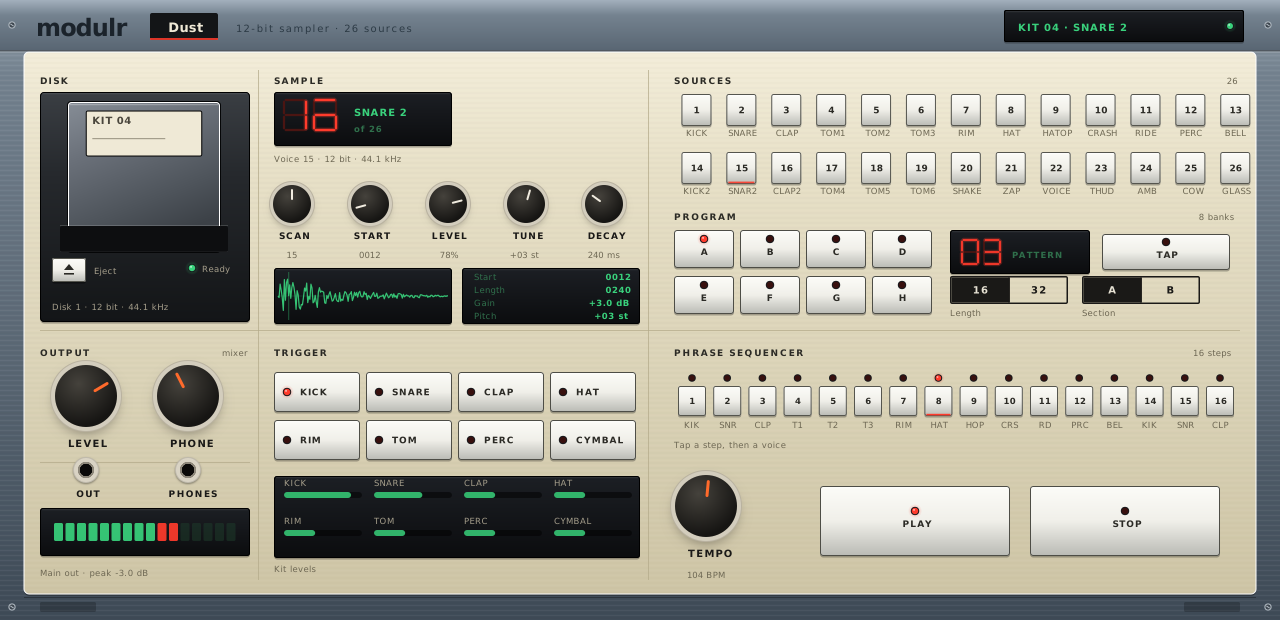
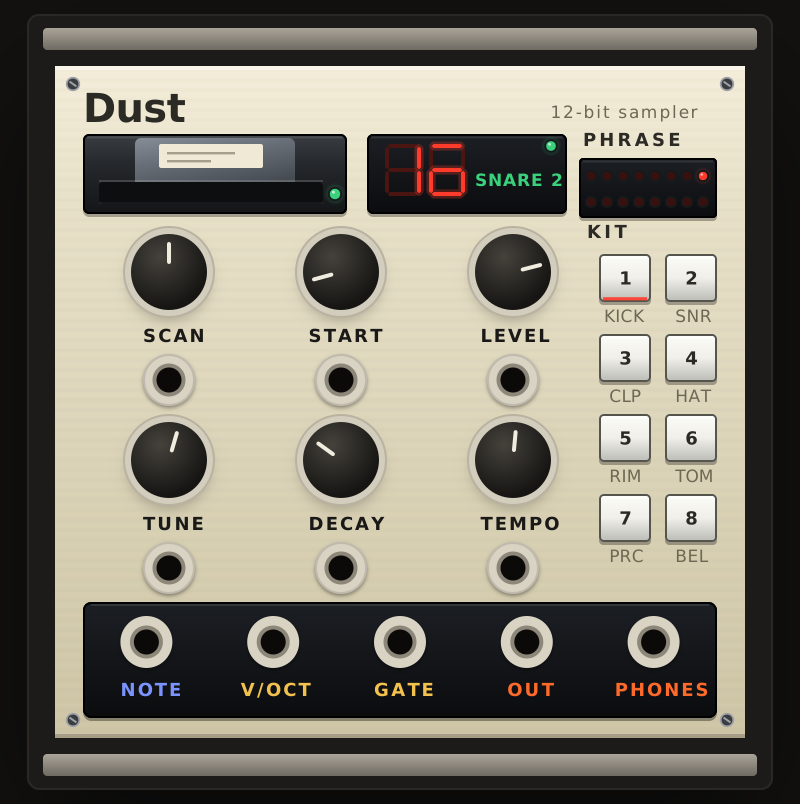
Mock UI — drawn by the specification’s own kit, not a screenshot of a shipped editor. Values are illustrative, not measured. The study is SP-1200’s grammar, redrawn in Modulr’s own words, and nothing on it is measured against the instrument.
SP-1200, 1987.
The instrument’s own grammar, as the catalogue recalls it: the sections, the controls and the look the study borrows.
The twelve-bit sampler grammar: a disk of samples, a two-digit display naming the voice, a knob per voice parameter (scan, start, level, tune, decay), a grid of source buttons and a sixteen-step phrase sequencer.
A cream panel in 26 HP inside a blue-grey steel rim: a black floppy bay with a disk half in its slot, a red two-digit sample display, sixteen phrase lamps, six black knobs with a control jack under each, eight kit buttons down the right and a strip of five jacks.
- A 3.5-inch floppy disk drive with a disk of its own
- A twelve-bit sampling voice with a start, a level, a tune and a decay for each sample
- A grid of buttons for the sample sources
- Trigger buttons and a phrase sequencer
- A small display and a knob that scrolls the samples
- An output mixer with a level and a phone amplifier
The module, knob by knob.
The macros are the signature controls a player reaches for, not a generic set; each one has a control jack under it on the module.
| Macro | Key | Range | Default |
|---|---|---|---|
| Scan | voice.scan | 1 – 26 | 1 |
| Start | voice.start | 0000 – 4095 | 0000 |
| Level | voice.level | 0 – 100% | 100% |
| Tune | voice.tune | -24 – +24 st | 0 st |
| Decay | voice.decay | 10 ms – 2.0 s | 2.0 s |
| Tempo | seq.tempo | 40 – 240 BPM | 120 BPM |
| Side | Jacks |
|---|---|
| In | Note (MIDI), V/Oct (CV), Gate (CV) |
| Out | Out (Audio), Phones (Audio) |
Legendary is the catalogue of the Modulr Synths project: 43 design studies drawn with the specification’s own kit, 33 after the synthesizers of all time and 10 after the drum machines. The makers and years named here are the instrument’s; the names, the layouts and every value are Modulr’s own.