Modulr Strap
One oscillator with a sub and noise, a resonant filter, a key sequencer and an arpeggiator, played from your keyboard as a VST3 and Audio Unit.
Modulr Strap is a monosynthesizer after the grammar of the 1982 SH-101: one oscillator with saw, pulse and a sub that sounds one or two octaves down, noise, a high-pass and a resonant low-pass filter, a single ADSR on sliders, a portamento and a bender, an arpeggiator and a key-recorded sequencer, all as sliders in a strip over a 32-key keybed. It plays one voice, and it is a VST3 and Audio Unit plug-in.
Five sounds, played as they ship.
Each clip is the plug-in itself: a patch is picked in the drawer and loaded, then a played line sounds on it, the way it is played into the plug-in from a keyboard. The bank holds fifty-two patches that make five distinct sounds, one for each role; these are one of each. No effects added, no mastering.
The editor, and the module it becomes.
The plug-in is built, and its editor is shown playing a patch. The Eurorack module drawn beside it, with its macro knobs and the control jacks under them, is a design study and is not built.
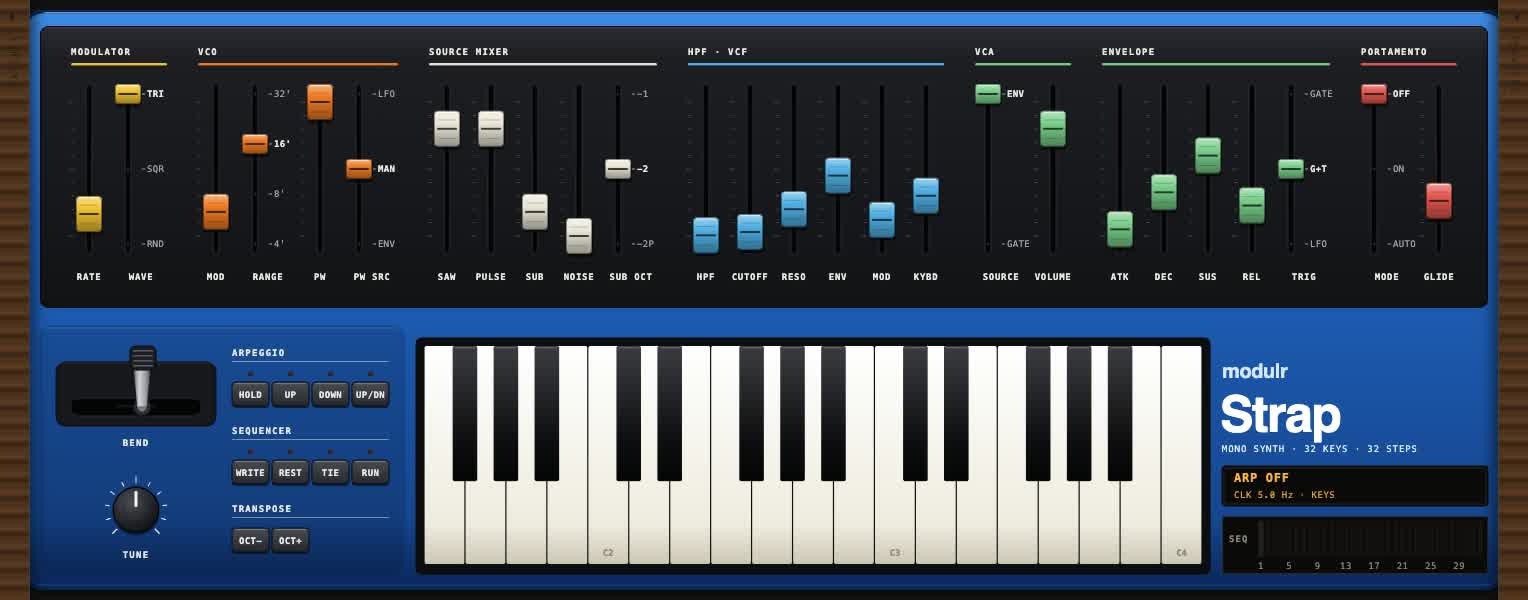
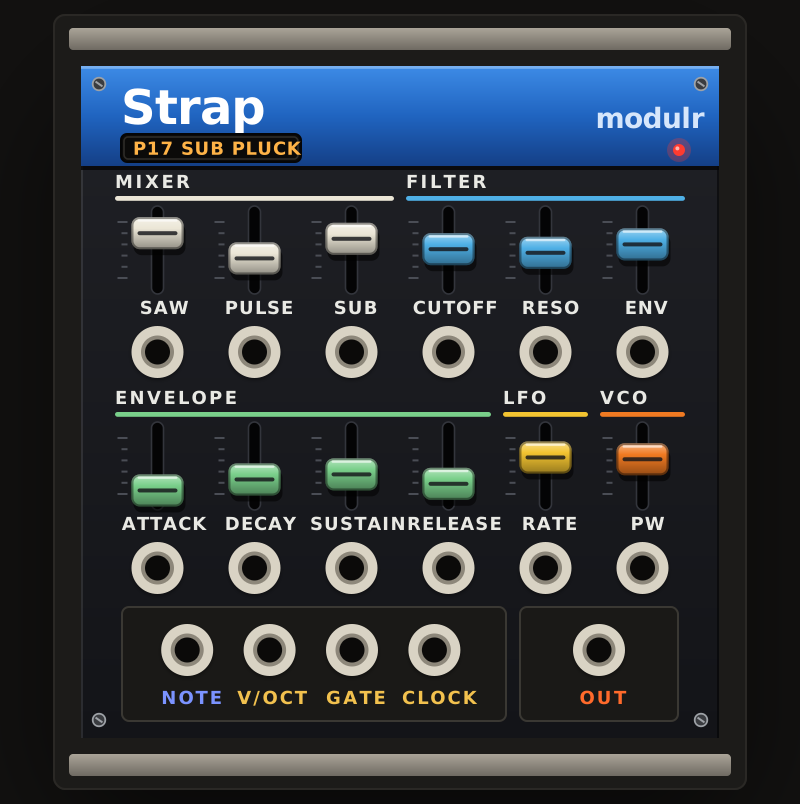
The editor is the plug-in’s own, captured as it plays. The module is drawn by the specification’s own kit, and its values are illustrative, not measured. The design is SH-101’s grammar, redrawn in Modulr’s own words, and nothing on it is measured against the instrument.
SH-101, 1982.
The instrument’s own grammar, as the catalogue recalls it: the sections, the controls and the look the study borrows.
The compact mono grammar: a modulator, one oscillator with pulse width and a sub, a source mixer of saw, pulse and sub, a high-pass and low-pass filter with envelope amount, and a single attack, decay, sustain and release envelope, all on sliders.
A handheld mono synth in 24 HP: a blue moulded head with the name and an amber patch window, then a black strip of twelve short sliders with large coloured caps, grouped by section with white lettering, a CV jack under each.
- Modulator: LFO rate and waveform
- VCO: range, pulse width and its source, saw, pulse, sub level and noise
- High-pass and low-pass VCF: cutoff, resonance, envelope, modulation and key follow
- VCA: gate or envelope
- Single ADSR on sliders, with portamento
- 32-step sequencer and arpeggio
- 32-key keyboard with a bender
- Handheld case with a shoulder strap and a grip
The module, knob by knob.
The module is a design study and is not built. Its macros are the signature controls a player reaches for, not a generic set; each one has a control jack under it.
| Macro | Key | Range | Default |
|---|---|---|---|
| Saw | mix.saw | 0–100% | 0% |
| Pulse | mix.pulse | 0–100% | 0% |
| Sub | mix.sub | 0–100% | 0% |
| Cutoff | vcf.cut | 20 Hz – 20 kHz | 20 kHz |
| Reso | vcf.res | 0–100% | 0% |
| Env | vcf.env | 0–100% | 0% |
| Attack | env.atk | 0 ms – 20 s | 2 ms |
| Decay | env.dec | 0 ms – 20 s | 200 ms |
| Sustain | env.sus | 0–100% | 70% |
| Release | env.rel | 0 ms – 20 s | 100 ms |
| Rate | lfo.rate | 0.1–40 Hz | 4.0 Hz |
| PW | vco.pw | 5–95% | 50% |
| Side | Jacks |
|---|---|
| In | Note (MIDI), V/Oct (CV), Gate (CV), Clock (CV) |
| Out | Out (Audio) |
Legendary is the catalogue of the Modulr Synths project: 43 design studies drawn with the specification’s own kit, 33 after the synthesizers of all time and 10 after the drum machines. The makers and years named here are the instrument’s; the names, the layouts and every value are Modulr’s own.