Modulr Copy
Twelve twelve-bit voices on a disk, a start, a pitch, a level and a decay for each, and a four-digit display.
Modulr Copy is a design study after the grammar of the S900 (Akai, 1985): a disk of twelve-bit sounds, a window of sample names, a start, a pitch, a level and a decay for each of the twelve voices, an edit knob that finds the next sample, and twelve kit pads that play them.
The editor, and the module it becomes.
Each study is drawn twice: as a standalone plug-in editor, and as a Eurorack module with its macro knobs and the control jacks under them. Nothing here is built.
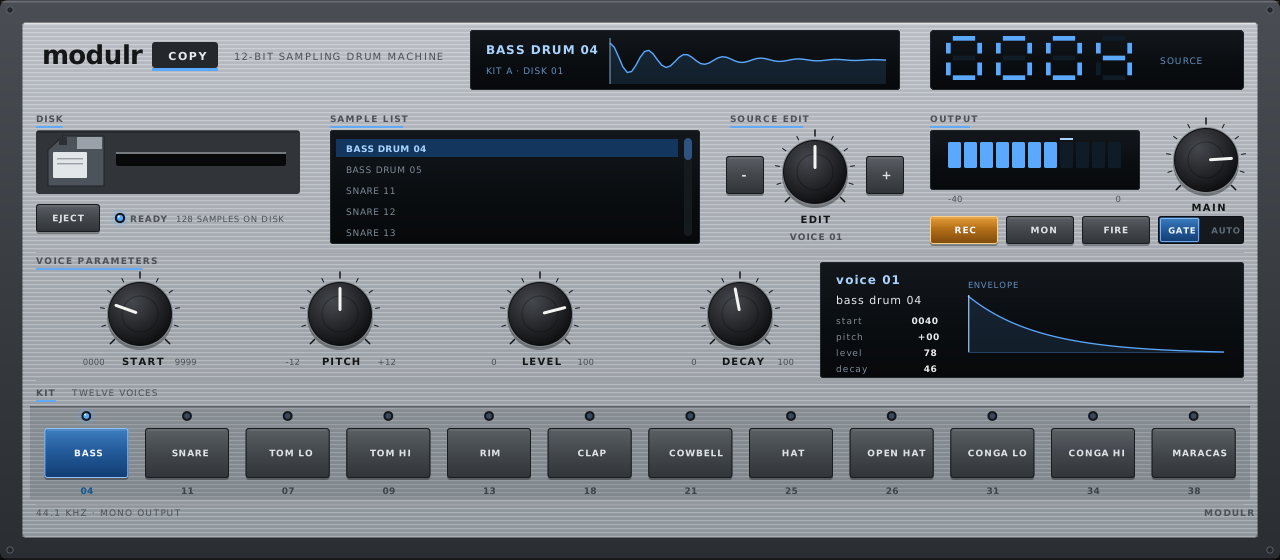
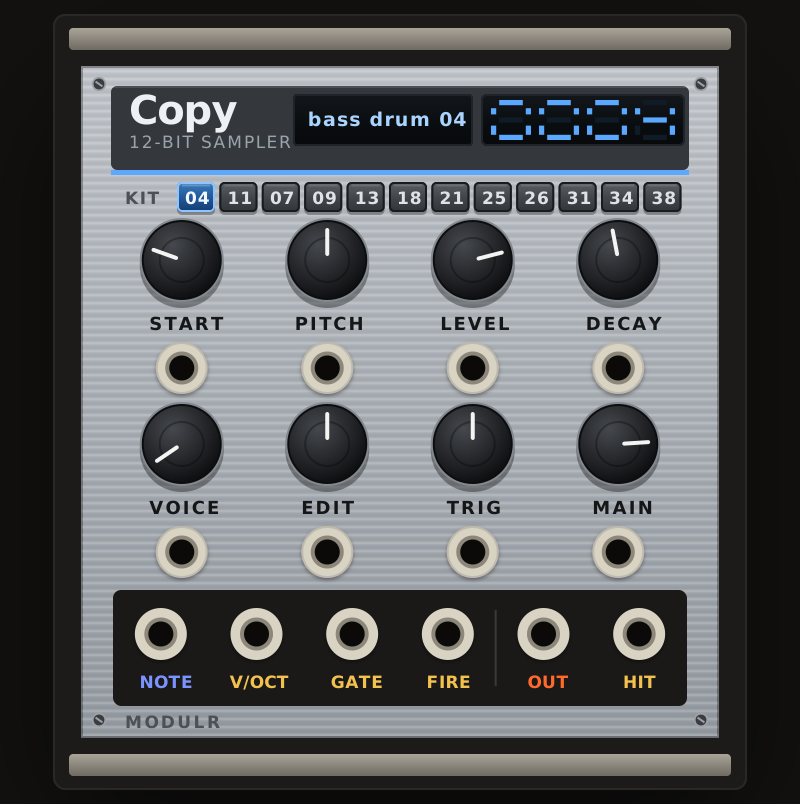
Mock UI — drawn by the specification’s own kit, not a screenshot of a shipped editor. Values are illustrative, not measured. The study is S900’s grammar, redrawn in Modulr’s own words, and nothing on it is measured against the instrument.
S900, 1985.
The instrument’s own grammar, as the catalogue recalls it: the sections, the controls and the look the study borrows.
The sampling drum machine grammar: a disk of twelve-bit sounds, a window of sample names, a start, a pitch, a level and a decay for the selected voice, an edit knob that finds the next sample, and twelve kit pads that play them.
A graphite case holding a brushed silver front panel: a blue four-digit source display, a 3.5-inch disk bay with a metal shutter, a list of sample names in a dark window, a big black edit knob between a minus and a plus key, a blue output meter and twelve dark kit pads with lamps over them.
- A twelve-bit sampling drum machine: a 3.5-inch disk with the sounds on it
- A plus and a minus button to find a sample
- A start, a pitch, a level and a decay for each of the twelve voices
- A trigger and a group of buttons to play the kit
- A four-digit display and a knob that edits the selected voice
The module, knob by knob.
The macros are the signature controls a player reaches for, not a generic set; each one has a control jack under it on the module.
| Macro | Key | Range | Default |
|---|---|---|---|
| Start | sample.start | 0000 – 9999 | 0000 |
| Pitch | sample.pitch | -12 – +12 st | +00 |
| Level | sample.level | 0–100% | 100% |
| Decay | sample.decay | 0–100% | 100% |
| Voice | kit.voice | 01 – 12 | 01 |
| Edit | sample.edit | 0000 – 9999 | 0000 |
| Trig | voice.trig | gate / auto | gate |
| Main | out.level | -inf – +6 dB | 0 dB |
| Side | Jacks |
|---|---|
| In | Note (MIDI), V/Oct (CV), Gate (CV), Fire (CV) |
| Out | Out (Audio), Hit (CV) |
Legendary is the catalogue of the Modulr Synths project: 43 design studies drawn with the specification’s own kit, 33 after the synthesizers of all time and 10 after the drum machines. The makers and years named here are the instrument’s; the names, the layouts and every value are Modulr’s own.