Modulr Grid
A grid of eight voices by eight patterns, read straight off the lamps, with a jam button that plays what the grid shows.
Modulr Grid is a design study after the LinnDrum of 1982. It borrows the grid grammar: patterns read straight off a matrix of amber lamps, a bank of pattern keys, a jam key that plays what the grid shows, and knobs for each voice.
The editor, and the module it becomes.
Each study is drawn twice: as a standalone plug-in editor, and as a Eurorack module with its macro knobs and the control jacks under them. Nothing here is built.
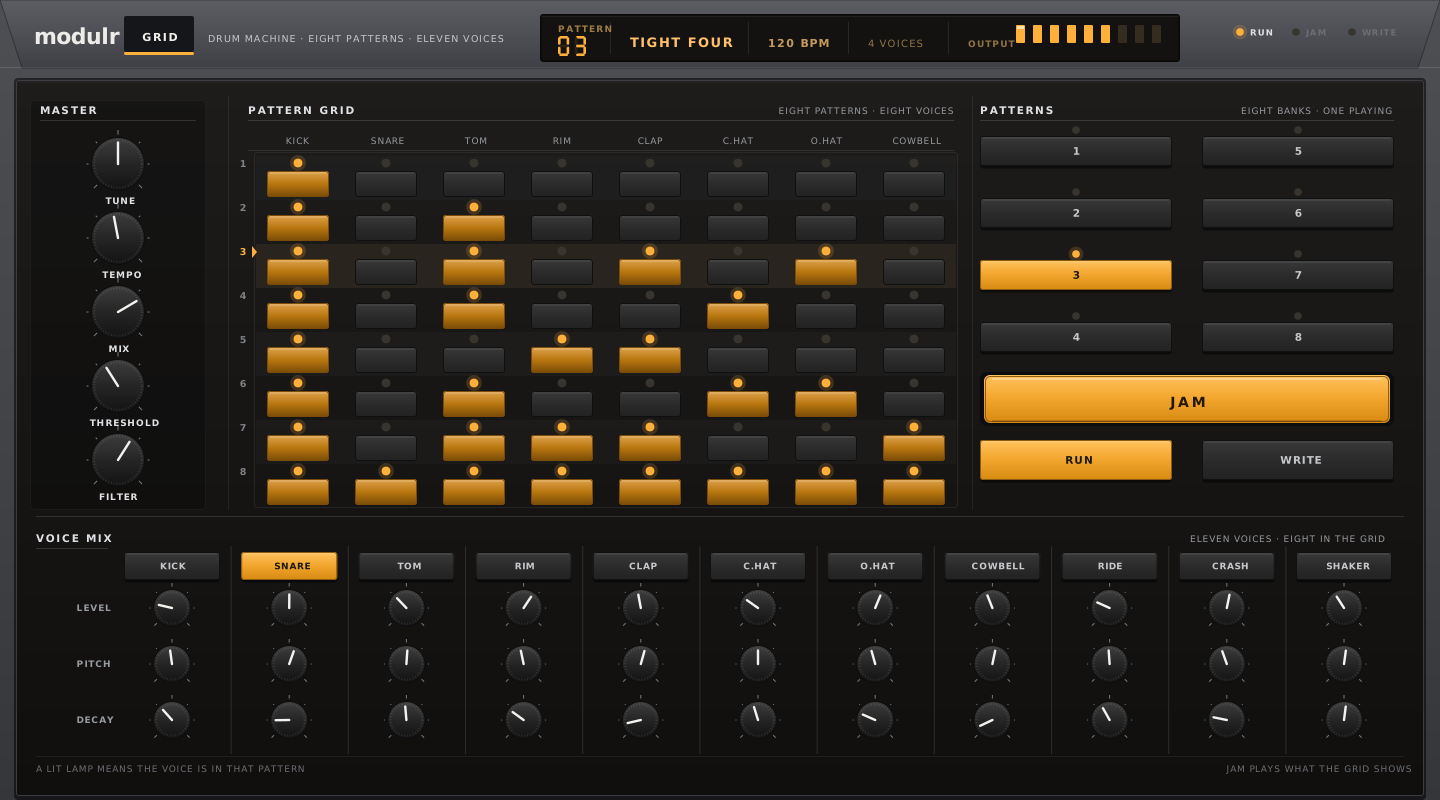
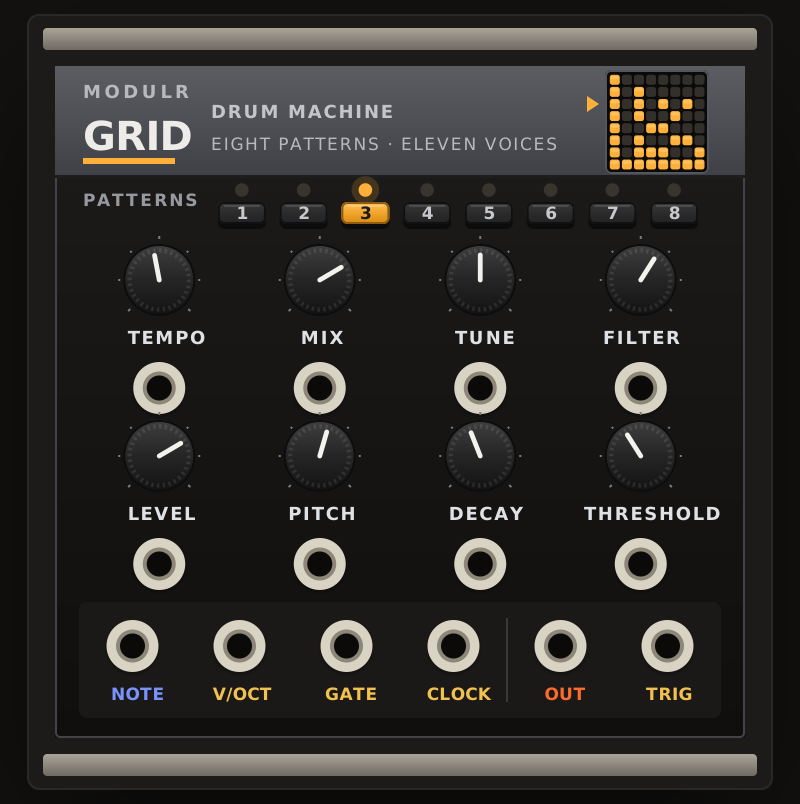
Mock UI — drawn by the specification’s own kit, not a screenshot of a shipped editor. Values are illustrative, not measured. The study is LinnDrum’s grammar, redrawn in Modulr’s own words, and nothing on it is measured against the instrument.
LinnDrum, 1982.
The instrument’s own grammar, as the catalogue recalls it: the sections, the controls and the look the study borrows.
The grid grammar: patterns read straight off a matrix of amber lamps, a bank of pattern keys and a jam key that plays what the grid shows, and small black knobs with white pointers for every voice.
A 26 HP panel in the machine's own grey and black: a grey title band over a black panel, the amber eight-by-eight lamp matrix sunk into the band as the signature, a strip of the eight pattern lamps, eight black macro knobs with white pointers in two rows, each over its own cream control jack, and the jacks in a dark tray.
- A grid of buttons: eight instrument columns by eight pattern rows, each with its own lamp
- Eleven voice buttons along the bottom, each with its own level, pitch and decay knobs
- A threshold control and a low-pass filter on the output
- A mix level for each instrument
- A bank of eight patterns and a jam button that plays what the grid shows
The module, knob by knob.
The macros are the signature controls a player reaches for, not a generic set; each one has a control jack under it on the module.
| Macro | Key | Range | Default |
|---|---|---|---|
| Tempo | seq.tempo | 40 – 240 BPM | 120 BPM |
| Mix | out.mix | -inf – +6 dB | 0.0 dB |
| Tune | out.tune | ±100 ct | 0 ct |
| Filter | out.filter | 200 Hz – 12 kHz | 12 kHz |
| Level | voice.level | 0 – 100% | 80% |
| Pitch | voice.pitch | -12 – +12 st | 0 st |
| Decay | voice.decay | 20 ms – 2.0 s | 400 ms |
| Threshold | trig.threshold | 0 – 100% | 20% |
| Side | Jacks |
|---|---|
| In | Note (MIDI), V/Oct (CV), Gate (CV), Clock (CV) |
| Out | Out (Audio), Trig (CV) |
Legendary is the catalogue of the Modulr Synths project: 43 design studies drawn with the specification’s own kit, 33 after the synthesizers of all time and 10 after the drum machines. The makers and years named here are the instrument’s; the names, the layouts and every value are Modulr’s own.