Modulr Titan
A weighted keybed, a ribbon and a joystick, with a brass layer and a string layer over one shared voice.
Modulr Titan is a design study after a two-layer, eight-voice polysynth of 1977. It borrows that instrument’s grammar: high-pass and low-pass cutoff with resonance and brilliance, long envelope sliders, preset tabs, a ribbon controller and a joystick.
The editor, and the module it becomes.
Each study is drawn twice: as a standalone plug-in editor, and as a Eurorack module with its macro knobs and the control jacks under them. Nothing here is built.
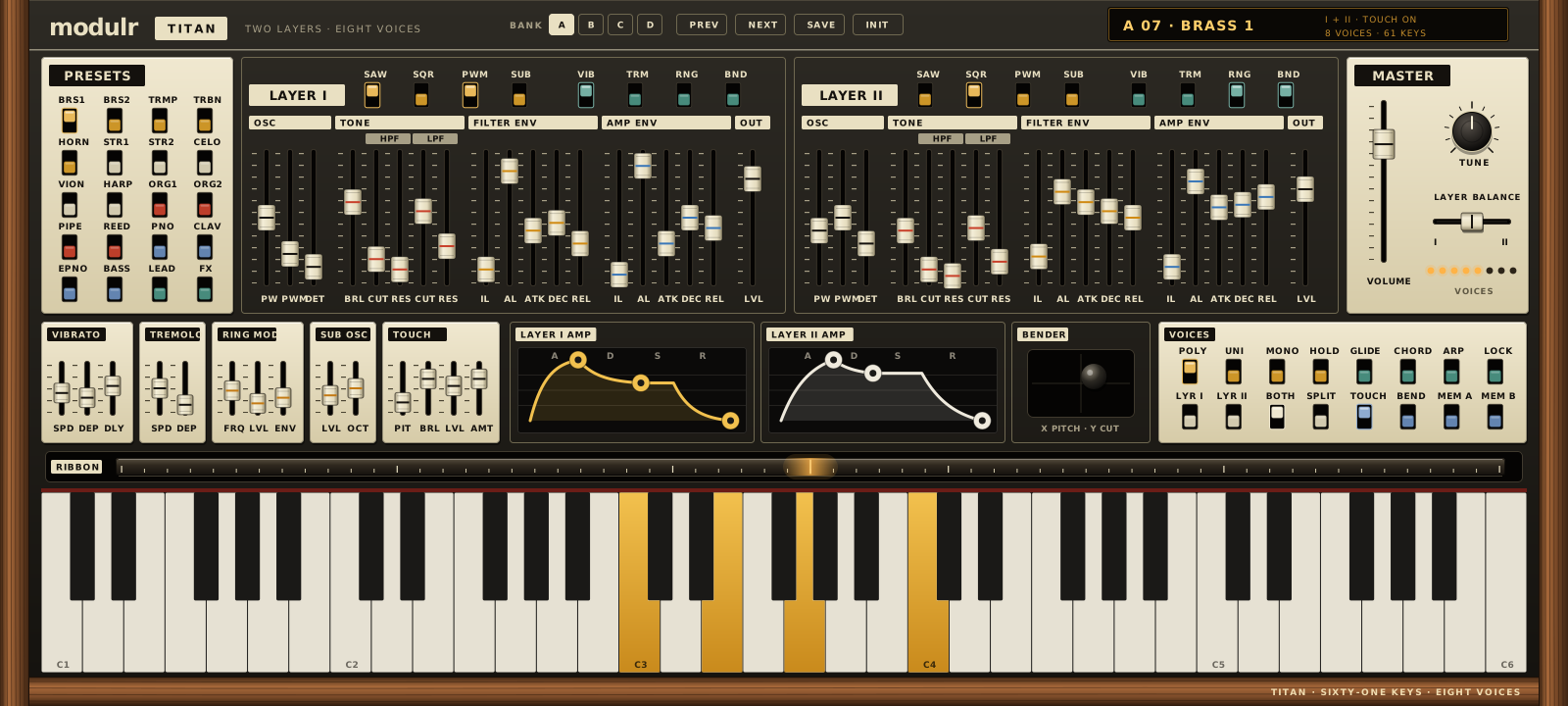
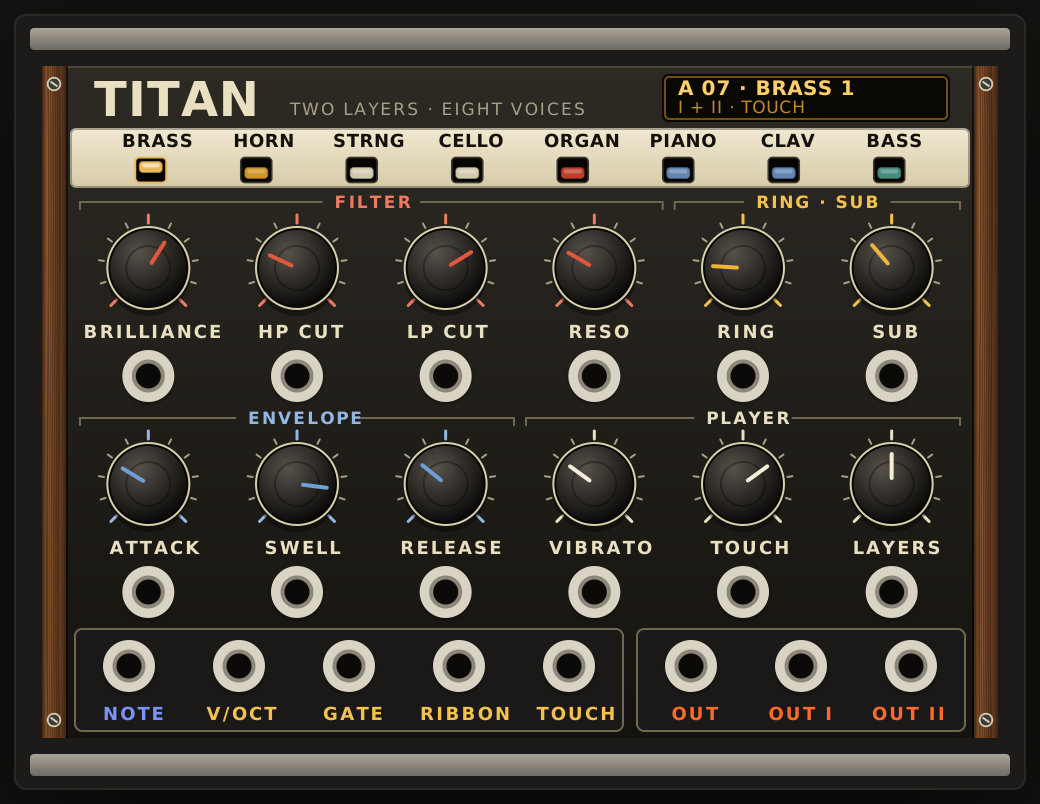
Mock UI — drawn by the specification’s own kit, not a screenshot of a shipped editor. Values are illustrative, not measured. The study is CS-80’s grammar, redrawn in Modulr’s own words, and nothing on it is measured against the instrument.
CS-80, 1977.
The instrument’s own grammar, as the catalogue recalls it: the sections, the controls and the look the study borrows.
The two-layer, eight-voice grammar: preset tabs for brass, strings and organ, a bright-to-dark filter with high-pass and low-pass cutoffs and a brilliance control, long envelope sliders with an initial and an attack level, a ring modulator, vibrato, and a ribbon and touch response for the player.
A wide black panel in 36 HP with cream legends between walnut end caps: a strip of coloured preset tabs, twelve black knobs with cream bezels in four bracketed groups, each pointer in its group colour over a printed arc and a CV jack, and the jacks in two dark trays at the foot.
- Two complete synthesiser layers (I and II)
- A filter section (high-pass and low-pass cutoff, resonance, brilliance)
- A long set of vertical sliders for the envelope and the level
- A brass, strings and organ preset row of tab switches
- A ring modulator
- A sub-oscillator and vibrato
- A ribbon controller for pitch and a joystick
- Polyphonic aftertouch
The module, knob by knob.
The macros are the signature controls a player reaches for, not a generic set; each one has a control jack under it on the module.
| Macro | Key | Range | Default |
|---|---|---|---|
| Brilliance | tone.brill | 0–100% | 50% |
| HP cut | hpf.cut | 20 Hz – 20 kHz | 20 Hz |
| LP cut | lpf.cut | 20 Hz – 20 kHz | 20 kHz |
| Reso | lpf.res | 0–100% | 0% |
| Ring | ring.lvl | 0–100% | 0% |
| Sub | sub.lvl | 0–100% | 0% |
| Attack | amp.atk | 0 ms – 20 s | 10 ms |
| Swell | amp.al | 0–100% | 100% |
| Release | amp.rel | 0 ms – 20 s | 200 ms |
| Vibrato | vib.depth | 0–100% | 0% |
| Touch | touch.amt | 0–100% | 50% |
| Layers | mix.bal | I – II | I = II |
| Side | Jacks |
|---|---|
| In | Note (MIDI), V/Oct (CV), Gate (CV), Ribbon (CV), Touch (CV) |
| Out | Out (Audio), Out I (Audio), Out II (Audio) |
Legendary is the catalogue of the Modulr Synths project: 43 design studies drawn with the specification’s own kit, 33 after the synthesizers of all time and 10 after the drum machines. The makers and years named here are the instrument’s; the names, the layouts and every value are Modulr’s own.